A Banquet of the Gods? A Masterclass in Iconography

A museum visitor looks at a painting for an average of seventeen seconds. Anyone who does that with this panel will only see the title confirmed: Banquet of the Gods. Other questions remain unanswered: where is the feast taking place? Who are the guests? What is on the menu? And above all: what is being celebrated?
Those who linger a little longer will notice that the panel is signed and dated on the wine barrel at the bottom right. The Latin abbreviation FF ĪV.E.F. 1550 means: “Frans Floris designed and made this in 1550.” The 16th-century Antwerp painter Frans Floris de Vriendt drew his antique inspiration from a study trip through Italy.
Responsible nudity
The banquet of the gods was an Italian Renaissance theme eagerly adopted by the Mannerists of the Low Countries. Divine nudity offered them an opportunity to showcase their anatomical knowledge. The muscular figure in the foreground not only displays his back but also his torso through the heroic breastplate he wears while mounted on horseback.
The Olympic gods are not gathered in their celestial palace, but in a pavilion on earth. Through the entrance, we catch a glimpse of a country house—perhaps the estate of the wealthy patron. The pavilion may thus allude to his garden. The depicted feast would have been placed in a dining room, where guests could guess the identities of the figures while enjoying the spectacle of artistically sanctioned nudity.
Guests
Let’s follow their example. At the very top, six little gods of love float above with weapons in hand. Anyone familiar with mythology will recognize the shield of the war god Mars, the flaming lightning bolt of the chief god Jupiter, the trident of the sea god Neptune, and the two-pronged scepter of the underworld god Pluto. One little god playfully tugs at Mercury’s winged helmet, while another pulls on Hercules’ menacing club.
Why are the little gods of love messing with these weapons? The answer is obvious: a feast is a time of reconciliation and harmony. The gods, who often wage war on one another, here set aside their armor. Far left sits Cupid, the little god of love who delights in targeting both gods and humans. Cupid is perched on his weapons, holding a rose of love in his hand: the time of the chase is over; it is now the time for the stability of marriage, personified by Juno. As is often the case, the scene should be read from left to right: from love to marriage. The first divine couple is easy to identify. The sky god Jupiter, with his gray beard, is accompanied by his eagle. The king of birds snaps jealously at the scepter of the sky goddess Juno. She reclines on a cloud, from which her favorite animal, the peacock, peeks out. The burning, crossed torches behind her indicate her role as goddess of marriage—they were carried in wedding processions. Juno’s own marriage was far from harmonious due to Jupiter’s continual infidelities. One of his favorites was the young shepherd Ganymede, who here offers him a cup. The chief god reminds his cupbearer that he must also serve his sulking wife. Jupiter’s attempt at reconciliation is one of the humorous details in the painting.
The depicted feast would have been placed in a dining room, where the guests could enjoy themselves amid artistically sanctioned nudity.
More gods
The goddess of love, Venus, sits to the left of her father, Jupiter. She waves pink love flowers to her lover, Mars. The god of war sits astride the cuirass he has set aside in this peaceful setting; it bears the Hercules knot, symbolizing the power of Roman generals and emperors. In the background, Mercury—the messenger of the gods, recognizable by his winged helmet—provides festive music with the aulos, or double flute, one of his inventions as a shepherd god. The third divine pair consists of brother and sister. The naked sun god Apollo is identifiable by his blonde hair, the bandolier of his quiver, and the devoted laurel. The modestly dressed maiden Diana, as goddess of the hunt, wears a short yellow dress. Next to Apollo, we recognize the bearded hero Hercules by the lion’s head serving as his helmet. He looks disturbed at the winged child trying to disarm him. At the lower right, two nature deities keep each other company. The grain goddess Ceres and the wine god Bacchus stand allegorically for the bread and wine that should never be missing at a feast. Ceres, mourning her daughter, rests in her floral dress atop sheaves of grain with a sickle and wildflowers. The corpulent Bacchus, crowned with ivy and holding a cluster of grapes, sits on a barrel. Above him, we recognize Pluto, god of the underworld, by his dark beard and two-pronged scepter. He embraces his dark-haired wife, Proserpina. Ceres’ daughter, Persephone, as a young goddess of grain, was allowed to spend two-thirds of the year on earth.
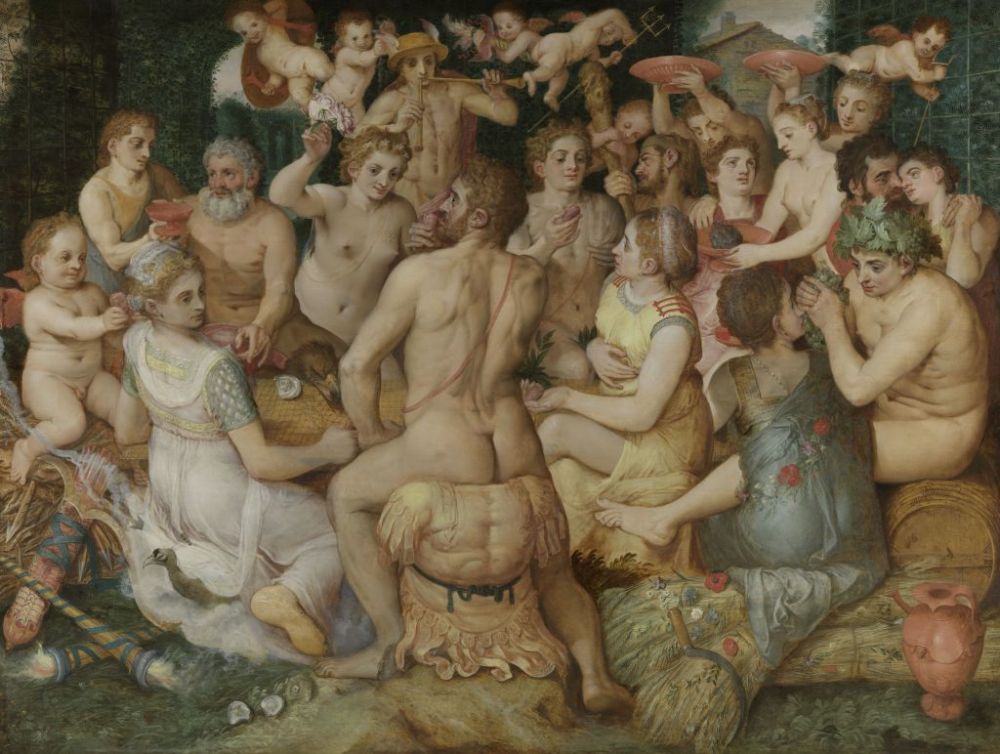
Banquet of the Gods - Frans Floris I, KMSKA
Wedding Feast
Finally, there is the enigmatic pair between Hercules and Pluto. A clue lies in Hercules’ hand, which he jovially rests on the shoulder of his neighbor: the young man in the red tunic is apparently an acquaintance. One of Hercules’ fellow warriors was the hero Peleus, who accompanied him on the Calydonian hunt, on an expedition against Troy, and during the Argonautic voyage. On that last journey, Peleus fell deeply in love with the sea nymph Thetis when she rose from the waves with her chest exposed, surrounded by Nereids (Catullus, Carmina, 64.18). At their wedding in Thessaly, all the gods and goddesses were in attendance.
The naked nymph, with her lustfully erect nipples, is undoubtedly Thetis, who as a sea goddess wears a pearl-adorned hairstyle. She offers her enthralled groom an artichoke. According to the botanist Dodoens, a contemporary of Frans Floris, this vegetable served “to stir up carnal desires.” Like the oysters, whose shells lie on the ground, it was thus considered an aphrodisiac. Peleus bears the facial features of his future son Achilles: reddish-brown hair, a clean-shaven face, and averted eyes. The two naked attendants presenting dishes are most likely Nereids, daughters of the sea god Nereus and sisters of their leader Thetis. Many details of the scene now fall into place. The disarmed god of love, Cupid, and the goddess of marriage, Juno, announce the wedding. The nets on the tables and the shells on the ground indicate that this is a sea-themed banquet. In Hendrick van Balen’s Marriage of Peleus and Thetis (Brussels, Royal Museums of Fine Arts), sea gods similarly arrive bearing fish and shellfish. Beneath Bacchus’ barrel is a jug decorated with shells, a crab, and two sea turtles—likely the wedding gift from the sea god Neptune to his granddaughter Thetis. The trident at the top had already hinted at his presence.
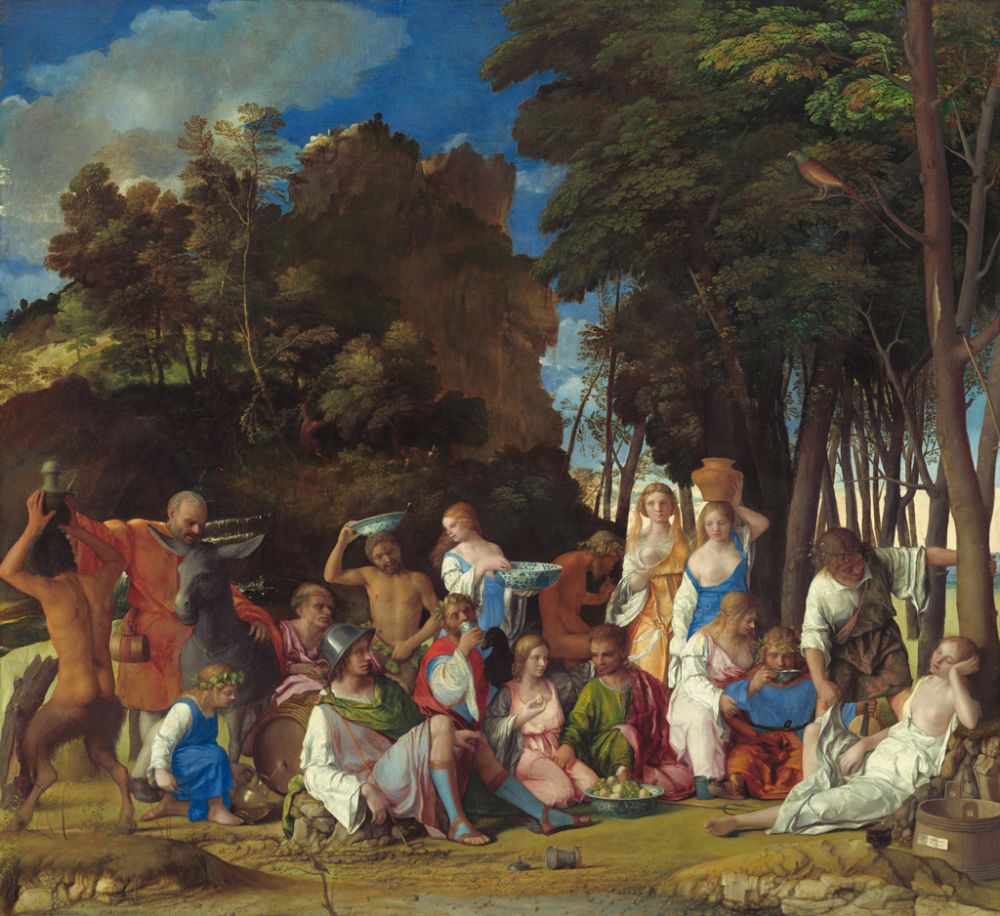
Feast of the Gods - Giovanni Bellini and Titian, National Gallery of Art, Washington, Widener Collection
Dessert: quince
After the main course, it is time for dessert. Bacchus is about to taste his own cluster of grapes, Thetis serves Peleus an artichoke, and three other gods hold an elongated fruit split at the top. We know of a similar depiction: the Feast of the Gods by Giovanni Bellini (Washington, National Gallery). In the center of that painting, a married couple sits on the ground: the bride, with her left arm around her husband, holds a quince in her right hand.
The apparent fruit of the quince tree is a traditional symbol of marriage. The Athenian lawgiver Solon even decreed that the bride should eat a quince before the wedding night to ensure fresh breath. Andrea Alciato recalls this rule in his Emblemata (CCIII). Cesare Ripa mentions the split fruit as a sexual symbol in his Iconologia (under Matrimonio, the article on marriage). The quince is also a symbol of duality in Plato’s Symposium or Feast.
None of the three gods in Floris’ painting seem particularly eager to eat this marital fruit. Mars hesitantly brings the quince to his mouth, Apollo eyes it suspiciously, and Diana makes a disgusted face, clutching her chest. Quince is barely edible due to its bitter taste. Mars and Apollo are not in a conventional marriage, and the steadfast virgin Diana also rejects the fruit—her gesture signals that her heart recoils in revulsion.
Grotesque details
The longer one studies the painting, the more jokes and antics emerge. Andrée de Bosque writes in her book Mythology and Mannerism in the Low Countries, 1570–1630 (1983) about Frans Floris: “He combines the ideas of the Renaissance with the imaginative vision of a Hieronymus Bosch, as seen in the Feast of the Gods at the Museum of Antwerp (1550), where grotesque and classical forms merge.” The improvised seating turns the elevated divine banquet into a wildly chaotic picnic. Cupid perches on his sharp weapons, Mars rides proudly on his armor, and Bacchus struggles to keep his balance atop his barrel. The entirely naked Venus openly flirts with her undressed lover. Ganymede’s cup is decorated with skulls. Ancient cups often bore symbols of death as a warning: “Drink, life is short.” This message seems absurd here: Jupiter is an immortal god, and his cupbearer may remain forever young on Olympus. The laurel leaves do not form a crown on Apollo’s head but, like fig leaves, cover his genitals. The sun god had been spurned by the nymph Daphne when she transformed into a laurel tree. The artichoke meant to stimulate Peleus’ desire is comically oversized. Bacchus boldly rests his left leg on the lap of a distressed-looking Ceres. This recalls the Latin phrase from Terentius: “Sine Cerere et Libero friget Venus” (“Without Ceres and Bacchus, Venus grows cold”: no steamy sex without food and drink). A learned painting like this offered its audience as much instruction as entertainment. By the end of the feast, every guest would have understood the true subject of the work: the wedding banquet of Peleus and Thetis.


