Sensuality and holiness in a single painting

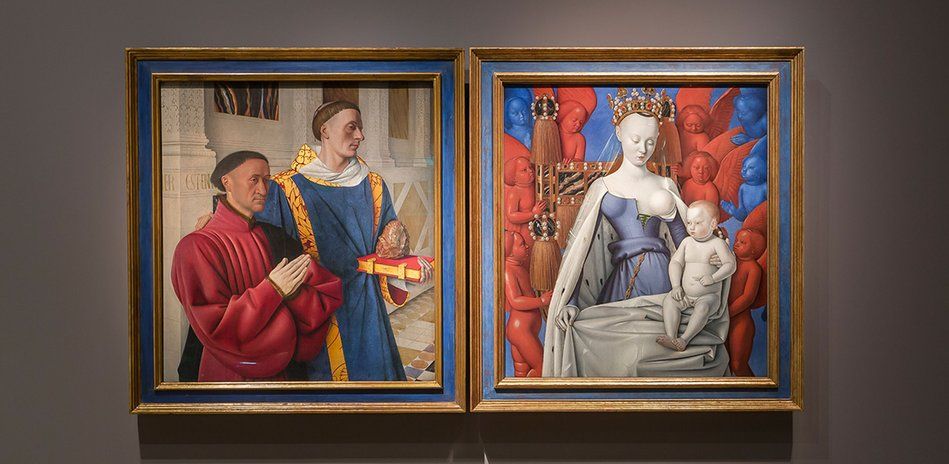
This intriguing Late Medieval masterpiece is the centerpiece of the KMSKA. Madonna Surrounded by Seraphim and Cherubim appears strikingly modern. Yet it was created by the French court painter Jean Fouquet in the mid-15th century. He made it on commission for Étienne Chevalier, treasurer to the French king Charles VII. Fouquet depicts the Virgin Mary as the Queen of Heaven: the exalted Mother of God. The painting captivates with its unusual, intense use of color and bold representation.
Beauty and holiness: feminine perfection
Rigid and still, Mary sits on her throne. Or is she standing upright? Behind her appear nine angels. The three blue cherubs symbolize purity and air, while the six red seraphs represent love and fire. Mary is dressed according to the noble fashion of the 15th century. Her cloak and crown emphasize her prominence. The tightly cinched waist accentuates her bare, full chest, giving the painting an almost erotic touch. It is believed that Agnès Sorel served as the model for the Madonna. Sorel was both the mistress and advisor of Charles VII. She was famous, and infamous, for her beauty. As a nursing Madonna, Sorel could embody the prevailing ideal of feminine beauty.
Melun diptych
The Madonna Surrounded by Seraphim and Cherubim is part of a diptych: the Melun Diptych, one of Fouquet’s most important works. The left panel is housed in the Gemäldegalerie in Berlin. It depicts two reserved men, businesslike and sharp as a razor. One is Étienne Chevalier, treasurer to King Charles VII and the commissioner of the work. Beside him stands his patron saint, Stephen, the first martyr of Christianity.
Madonna and Child
Against the trends of his time, Fouquet paints the Madonna as a sensual and fashionable woman. Typical of his work are the crystal-clear aloofness and absent gaze he gives his figures. The child on her lap shows no interest in her breast, and Mary does not actively encourage him to nurse. The attention of the infant Jesus is elsewhere. He points toward the other panel of the diptych—specifically to the commissioner, Étienne Chevalier, who is out of view. It is as if he is telling his mother: “That man deserves his place in heaven. Say a good word for him up there.”
Seraphim and Cherubim
The red and blue angels in Madonna Surrounded by Seraphim and Cherubim are a typical feature in Italian painting of the 14th and 15th centuries. Their colors were therefore not an “invention” of the artist, but a familiar representational method of the time. Blue and red were also the colors of the Parisian coat of arms, while white symbolized royalty. Above her dress, the Virgin also wears a mantle of ermine, the “royal fur.” The work thus carries a political dimension as well, celebrating France and the French monarchy.


