Ensor and Wojtkiewicz in Warsaw

By Dr. Cathérine Verleysen
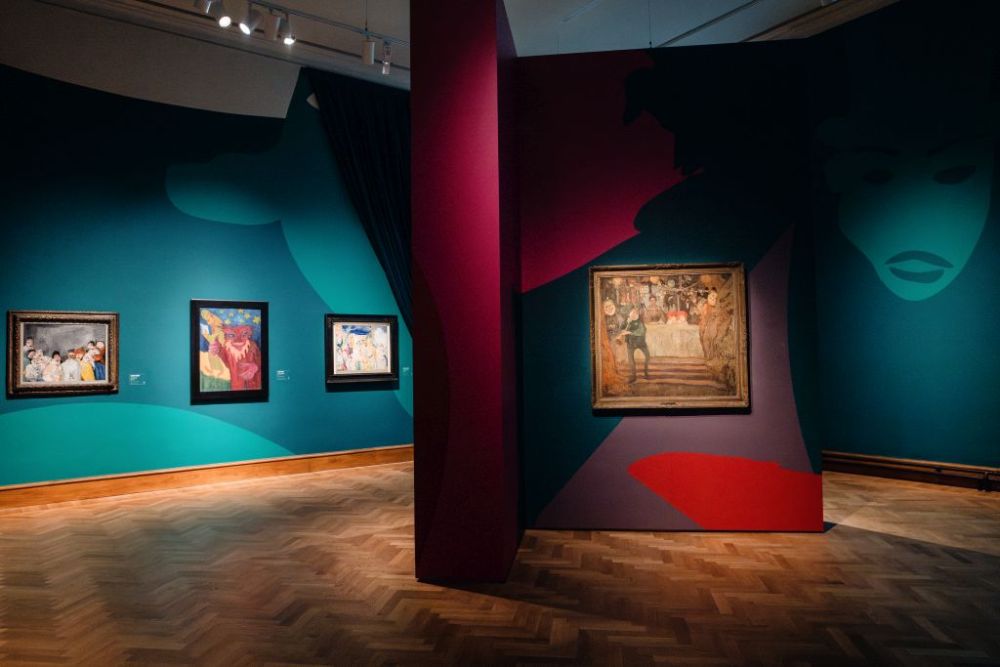
With the exhibition Black Carnival. Ensor / Wojtkiewicz, the National Museum in Warsaw offers, until January 11, 2026, a surprising journey through two worlds filled with fantasy, satire, and mystery. Although James Ensor (1860–1949) and the Polish artist Witold Wojtkiewicz (1879–1909) never met, they are united today in a shared visual language in which masquerade, absurdity, and a fascination with death take center stage.
James Ensor painted bustling, colorful scenes teeming with masks, monsters, and carnival parades, where humor and fear, life and death challenge one another. His world is at once comic, chaotic, and razor-sharp—like a caricature of humanity itself. Wojtkiewicz, who died young, by contrast created tender, melancholic depictions of dolls, children, and fairy-tale figures. He placed them in fragile, seemingly innocent settings. Together, the artists remind us that behind every face, another story invariably lies hidden.
Masquerade as a mirror of life
The Belgian artist James Ensor drew inspiration from a rich tradition of satire, nonconformity, and popular theatricality. He found inspiration close to home: in his seaside hometown of Ostend, where he grew up surrounded by masks, music, and the sea. The old masters, including Bosch and Bruegel, as well as artists such as Goya and Watteau, also fired his imagination. His paintings burst with energy. Masks, clowns, and skeletons dance through colorful, exuberant festivities that are both joyful and unsettling. For behind the spectacle lies his sharp gaze on humanity. Ensor reveals how we all wear masks—how we conceal our vanity, hypocrisy, and vulnerability, yet are simultaneously exposed by them.
A sense of fragility, silence, and dreamlike stillness characterizes the world of Witold Wojtkiewicz. The artist drew inspiration from cabaret, satirical theater, and the colorful nativity scenes of Kraków, the city where he lived and worked. He chose tender, poetic colors and populated his paintings with figures that radiate gentleness, yet essentially embody deep melancholy and alienation. In his scenes, the human figure appears wooden, while the dolls seem surprisingly alive. For the Polish artist, the mask is not a disguise but a mirror of the soul—one that moves and intrigues.
The world turned upside down
In the work of James Ensor and Witold Wojtkiewicz, two worlds meet that share surprisingly much in common. Both artists are guided by the same themes: masks, dreams, longing, and death. Behind their colorful scenes lies a deeper truth about humanity and its many faces. In their hands, reality is turned upside down: madness, chaos, and anarchy take on a liberating force, as if life itself is allowed to fall out of step. Their paintings resemble a festivity filled with masks and clowns, yet those who look closely glimpse fear, vulnerability, and longing beneath the surface.
With a sharp, at times merciless gaze, the two artists observed the world around them. They saw how life unfolds as both comedy and tragedy—a constant interplay between beauty and transience. Together, they created art that is at once playful and poignant, rich in irony and dreamlike absurdity, revealing humanity in all its contradictions—laughing and crying at the same time, searching for meaning behind the mask of existence.
Circus - In Front of the Little Theatre - Witold Wojtkiewics, on loan from the National Museum in Warsaw for the exhibition In your wildest dreams at the KMSKA
A unique collaboration between Poland and Belgium
Black Carnival. Ensor / Wojtkiewicz is the result of an exceptional collaboration between the National Museum in Warsaw and numerous Belgian private collectors and public institutions. The KMSKA made three works available: Skeletons Fighting over a Hanged Man, Astonishment of the Mask Wouse, and Carnival in Binche. In addition to paintings and drawings by Ensor and Wojtkiewicz, the exhibition also features marionettes, masks, and carnival costumes.
The idea for this imaginary dialogue between the two artists originated during the preparations for the exhibition In your wildest dreams. Beyond Impressionism, for which curator Herwig Todts selected several paintings by Wojtkiewicz. For the exhibition in Warsaw, Herwig Todts—and with him the KMSKA—was once again closely involved, driven by the ambition to continually position Ensor’s multifaceted oeuvre within an unexpected, internationally oriented context.


