Georges Vantongerloo: Master of Abstract Art

Georges Vantongerloo is one of the most important figures in international abstract art. His work is featured in some of the world’s most renowned museum collections, from the Centre Pompidou in Paris to the Guggenheim in New York. And now also in the KMSKA’s own collection.
The KMSKA acquired one of Vantongerloo’s most striking spherical creations, Circonvolution from 1948. This work creates a link between abstract art, science, and outer space. The museum already displays two Vantongerloo loans, but this is the first piece by the artist to belong to the KMSKA’s permanent collection.
The acquisition was made possible with funds from the Lens-Ghesquière Fund and fits beautifully with the works previously purchased by Gilberte ‘Gigi’ Ghesquière and her husband John Lens.

© Sigrid Spinnox

© Sigrid Spinnox
About Georges
Georges Vantongerloo (1886–1965), born in Antwerp, displayed extraordinary talent from an early age. After studying at the Royal Academy of Fine Arts in his hometown and the Académie des Beaux-Arts in Brussels, Vantongerloo supported himself through grants, including one from the royal court. His artistic journey began with figurative sculptures, which he exhibited in Charleroi, Liège, Brussels, and at the 1913 World Exhibition in Ghent.
When you look at the firmament with all that it reveals, aren’t you deeply moved by the great question mark? A work of art can evoke the same emotion. Without imitating reality, it can, through a non-objective finite form, evoke and embrace the infinite, the immeasurable.
Four periods
Vantongerloo’s artistic career can be divided into several phases, each with its own unique style and focus. D’après nature (1914–1916) represents an early stage in his artistic development. In 1916, he met Theo van Doesburg, which introduced him to the ideas of abstract art. He was a co-signatory of the First Manifesto of De Stijl and also contributed for three years to the journal of the same name.
Little is known about the two early periods, Vérifiée géométriquement and Fonction. His later work, however, provides a clearer view of his evolution as an artist. During his Période libre, Vantongerloo embraced a free style with an emphasis on curves, as seen in works such as Courbes and Fonction de Courbes. In his fourth period, Création, he explored the invisible energetic forces of the universe. This is the period in which Vantongerloo created Circonvolution.
Circonvolution or Kronkelingen
Circonvolution (1948) stands out with its vibrant colors, suggests movement, and embodies Vantongerloo’s brilliant mind.
This work is a valuable addition to our Modern Masters collection, allowing us to showcase the impact of this extraordinary artist on abstract art. It marks a historic step for the museum and offers visitors a unique opportunity to admire a seminal piece by one of Belgium’s most renowned abstract artists.
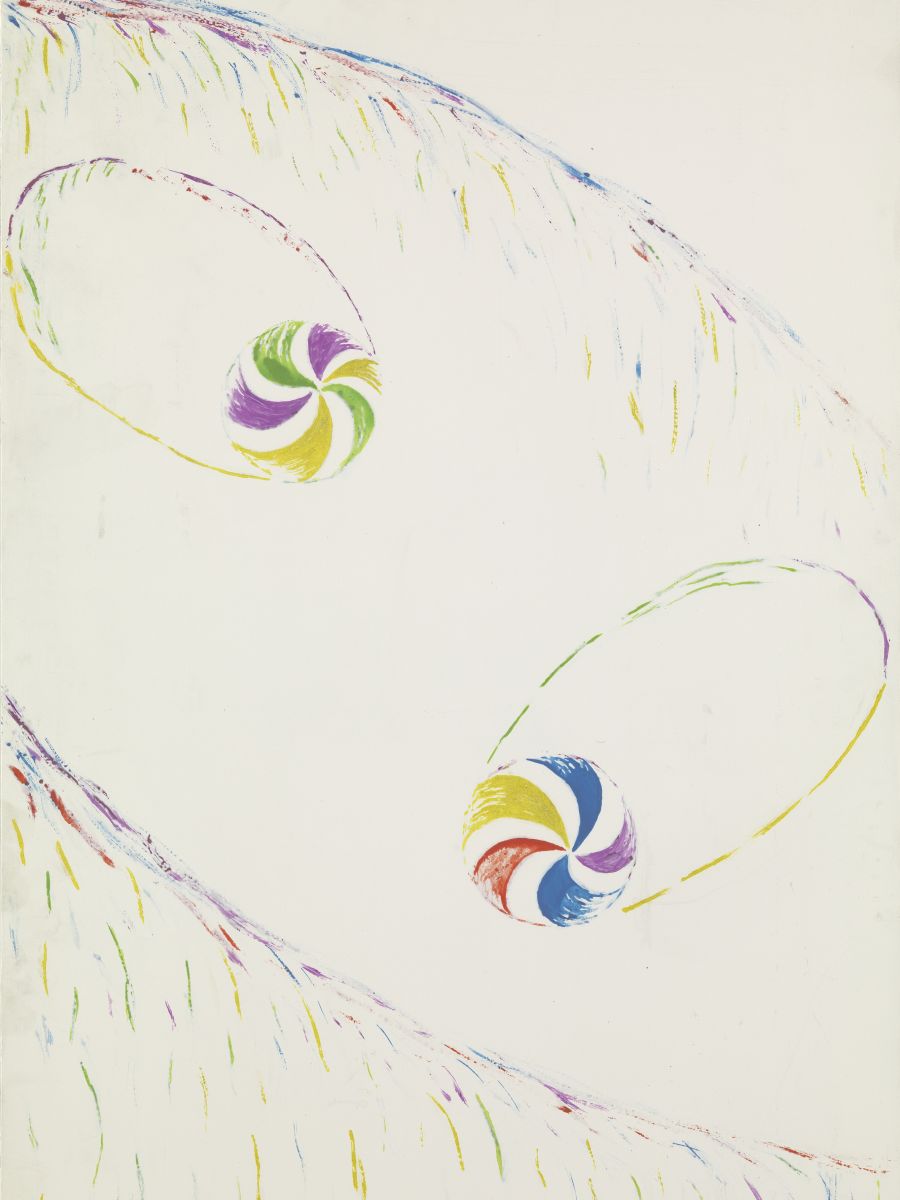
Circonvolution, 1948 - Georges Vantongerloo, 1886 - 1965
Visit the collection
Dive deeper into the cosmic dimensions of Circonvolution and experience the world of abstract art by Georges Vantongerloo and other Modern Masters at the KMSKA.


