La Sortie makes its debut at the KMSKA

The artist Ronald De Preter (b. 1954) donates his work La Sortie d’Ensor de Belgique to the KMSKA. In 1988–89, De Preter created this satirical reinterpretation of Ensor’s The Entry of Christ into Brussels in 1889 as a pointed response to the loss of this iconic work for Belgium, after it was sold to the J. Paul Getty Museum in Los Angeles.
By accepting the donation of Ronald De Preter’s La Sortie d’Ensor de Belgique, the KMSKA aims to ensure that James Ensor’s The Entry of Christ into Brussels in 1889 continues to resonate within its collection. The painting not only demonstrates how effortlessly Ensor’s work can be brought into contemporary relevance, but also underscores the museum’s ongoing responsibility, together with the relevant authorities, to preserve and manage important cultural heritage.

The Entry of Christ into Brussels in 1889 (1888–1889) - James Ensor (Ostend 1860 - Ostend 1949), J. Paul Getty Museum, Los Angeles

La sortie d’Ensor de Belgique (1988-1989) - Ronald De Preter (Lier, 1954), KMSKA, Flemish Community Collection, inv. no. 4384, Gift of the artist
Timeline
THE ENTRY OF CHRIST INTO BRUSSELS IN 1889
LA SORTIE D’ENSOR DE BELGIQUE

ANNUAL SALON LES XX

STUDIO ENSOR

REJECTED BY LES XX?

PALACE OF FINE ARTS, BRUSSELS

GUSTAVE NELLENS

LOUIS FRANCK JR AND KMSKA

J.PAUL GETTY MUSEUM
RONALD DE PRETER

KMSKA
Who is Ronald De Preter?
Ronald De Preter (b. Lier, 1954) studied drawing at the Royal Academy of Fine Arts Antwerp – DKO in the late 1970s and initially established himself primarily as a watercolorist. Later, he expanded his techniques to include oil painting and etching. He explores themes such as transience, vulnerability, and the fragility of the body, often depicted through nude figures or studies of slaughtered animals.
De Preter works primarily in series, which allows him to further explore the possibilities of painting and etching techniques. Natural light also plays an important role in shaping and accentuating his imagery. De Preter’s oeuvre reflects his inner world and the fleeting beauty of life.
Ronald De Preter: “On my first visit to the KMSKA, at the age of seventeen, James Ensor’s work was an immediate revelation for me. Above all, The Entry of Christ into Brussels captivated me and never let go. In the years that followed, I spent countless hours in the Ensor room, continually fascinated by this masterpiece.
When The Entry of Christ into Brussels later left the museum, it left a great void. The loss of this iconic work was a real shock for me. As a protest and out of dissatisfaction, I immediately began working on La Sortie d’Ensor de Belgique, a pastiche. This work is my personal dialogue with Ensor, a story that began half a century ago in this very museum. On the occasion of the Ensor Year, I am offering this work as a donation.”
Do you recognize all the characters?
The answers are shown below the image.
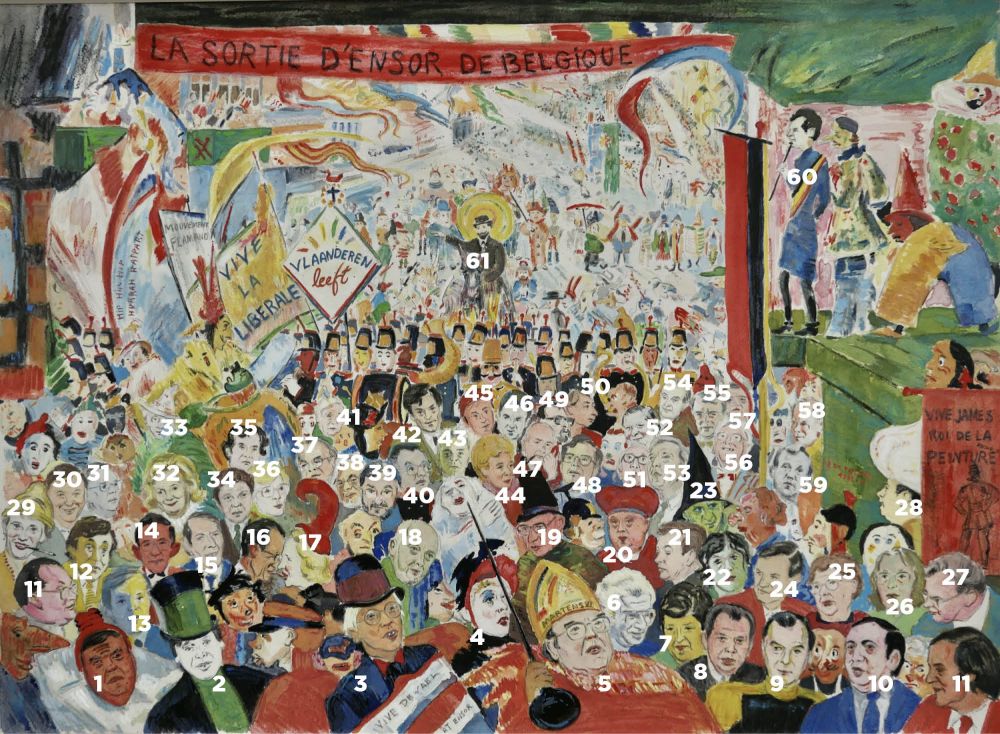
1. Louis Tobback 2. Patrick Dewael 3. Guy Verhofstadt 4. Annemie Neyts 5. Wilfried Martens 6. Willy De Clercq 7. Miet Smet 8. Frank Swaelen 9. Leo Tindemans 10. Jean Gol 11. Jean-Luc Dehaene 12. Hugo Schiltz 13. Jaak Gabriëls 14. Willy Claes 15. Jan Lenssens 16. Koning Boudewijn 17. Koningin Fabiola 18. Ludo Dierckx 19. Guy Spitaels 20. Paul Akkermans 21. Gaston Geens 22. Mieke Vogels 23. Jos Geysels 24. François-Xavier de Donnea 25. Paula D'hondt 26. Magda Aelvoet 27. Daniël Coens 28. Marc Eyskens 29. Wivina Demeester 30. Hans De Belder 31. Frans Grootjans 32. Rika De Backer 33. ‘Zelfportret' 34. Theo Kelchtermans 35. Eric Van Rompuy 36. Rika Steyaert 37. Willy Cuypers 38. Jean-Pierre Van Rossem 39. Herman De Croo 40. Jacky Buchmann 41. Bob Cools 42. Jan Hoet 43. Jan Decorte 44. Antoinette Spaak 45. Guy Coëme 46. Norbert De Batselier 47. Paul Vanden Boeynants 48. Melchior Wathelet 49. André Cools 50. Alain Van der Biest 51. Henri Simonet 52. Etienne Vermeersch 53. Charles-Ferdinand Nothomb 54. Joseph Michel 55. Jos Dupré 56. Philippe Moureaux 57. Freddy Willockx 58. Herman Van Rompuy 59. Ward Beysen 60. José Happart 61. James Ensor


