Tempestuous women

Catharina van Hemessen is the first artist (m/f/x) ever to portray herself holding brushes and a palette in her hands. Clara Peeters pioneers highly realistic fish still lifes and Henriëtte Ronner-Knip applies the same power of observation to domestic animals. Adèle Kindt and Virginie Demont-Breton win one medal after another during their lifetimes. Michaelina Wautier occupies herself with religious works, something that is in fact reserved for men only. These women are celebrities in their time and make a living from their art. And then they die. And their works disappear, art historians attribute their paintings to men, or they are completely ‘forgotten’. What do these women have in common? That you can see their work at KMSKA. Ah, and that they are the subject of this article.
It is undeniably true. There are distressingly few women whose work has made it into the KMSKA collection. That does not mean the museum does not wish to show art by women. On the contrary, it sought loans from private collectors to supplement its own limited collection of art by women. A small guide full of heroines.
Self-assured
Catharina van Hemessen (1528-after 1581) is the daughter of the Antwerp painter Jan van Hemessen. She learns the craft from her father. At the age of 20 she creates a self-portrait, as an artist, complete with easel, palette and brushes. For the first time, ever. Self-portraits already circulate. By Albrecht Dürer (1471-1528), for example, who gives Jesus his own features. No less self-assured, Van Hemessen writes in Latin at the top of her portrait “I, Catharina van Hemessen, painted myself, 1548, at the age of 20.” A pioneer, Van Hemessen is moreover the first female artist from the Low Countries known to us. The Italian writer Giorgio Vasari (1511-1578) even mentions Catharina in his compendium of artists’ biographies, including Michelangelo. Vasari was rather reluctant to include women in his book. Van Hemessen can count on a wide clientele, and on the enthusiastic support of Mary of Hungary, Governor of the Habsburg Netherlands.

The woman Catharina van Hemessen painted is not to be trifled with. - Portrait of a Woman, Catharina van Hemessen (after 1548) (detail)

Michaelina Wautier portrays ‘Agnes’ with great subtle sensitivity. - Two Girls as Saint Agnes and Saint Dorothy, Michaelina Wautier (detail)
We do not really know who taught Michaelina Wautier to paint. We do know that she lived unmarried in Brussels, sharing a studio and house with her painter brother Charles. She was not one for conventions or for the restriction that limited women to painting only still lifes or portraits. A nuance: she did master these genres, but she also ventured into more traditionally male categories: mythological scenes and altarpieces. Besides including the necessary nudes and anatomically correct flesh in her large Triumph of Bacchus, Wautier does something unprecedented. She places herself in the painting, with a bare breast, thereby taking a far more daring step than Catharina van Hemessen. Although Wautier also creates a self-portrait as a painter. Michaelina can handle anything. The museum owns two works by Wautier, TTwo Girls as Saint Agnes and Saint Dorothy and a study head.
As with Catharina van Hemessen, whose portrait of a woman can be found near Agnes and Dorothea in the museum, Wautier’s sitters are real people with a character of their own. Wautier, who lived to be over 80, excels in subtlety and psychological depth. Since her first solo exhibition in 2018 at MAS, this powerhouse has finally been gaining recognition again. And that Triumph of Bacchus? It was indeed part of the collection of Archduke Leopold Wilhelm. Yes, once again a governor of our regions.
Anatomy
Artemisia Gentileschi (1593-1653), like Catharina van Hemessen, began in the workshop of her renowned father Orazio, in Rome. It soon became clear that she had more talent than her brothers. Even more than Wautier, Gentileschi painted religious and mythological scenes, creating ‘portraits’ of deeply human saints. She was a master of anatomy. She often gave her heroines her own face. She chose her subjects very deliberately. In Artemisia’s time, however, artists depended on commissions, and thus on the wishes of their patrons. Yet Gentileschi’s legacy features a wide array of strong women, often from the Old Testament. Susanna, Lucretia, Catherine, Jael, and above all Judith. Artemisia painted two versions of the biblical story in which Judith beheads the enemy general Holofernes. They are the bloodiest versions in existence, although Judith was a popular subject. Thanks to a private collector, KMSKA can now also show a work by Artemisia Gentileschi. Not a strong woman, but David and Goliath (see image at the top of the article). The underdog David defeating a giant must have struck a sensitive chord. Artemisia was raped as a late teenager. The physiognomy of the beheaded Goliath also bears a certain resemblance to that of Holofernes.

Give the People what They want, Marlene Dumas (1992)

Schmerzensmann I, Berlinde De Bruyckere (2006) - photo Karin Borghouts
Today, women can of course enjoy a full art education. This is evident in the work of Marlene Dumas (b. 1953). Her work features quite a lot of nudity. Dumas is one of the best-known Dutch artists and often draws inspiration from contemporary cultural expressions, from pornography to photos of celebrities, and much more. These are then given a Dumas makeover in dark oil paint or dripping ink. Give the People what They Want is such a disorienting painting, full of ambiguity and tension, typical of Dumas’ work. The museum also has this work on loan from a generous private collector. It offers a striking commentary on the female figures in the Madonna room.
Belgian artist Berlinde De Bruyckere (b. 1964) also makes the human body her subject, sometimes of people, sometimes of horses. She is best known for her blanket women, women bent under blankets, full of symbolism. Equally powerful is the work Schmerzensmann I. The contorted wax figure provides a haunting and fragile image of the human body. For this reason, it fits perfectly in the Suffering room at KMSKA, also on loan.
Keen powers of observation
Clara Peeters (ca. 1588–ca. 1657) is the queen of still life. In the early seventeenth century, the genre began to gain popularity. Shifts in religious practice changed the tastes of citizens who could afford a painting. Everyday life crept into the art world. It was considered a safe subject for women. And that may be true. But Peeters discards the idealized visual language of her time and paints household objects in hyper-realistic detail—it is avant-garde. She was the first to start adding fish, the first to place hunted animals on the table. All depicted with meticulous precision, capturing all the different surfaces and textures. And she earned a good living from it. Her work was even sought after in Spain. How can we identify a Peeters among a mountain of still lifes? Ha! If she didn’t sign a work, she would add a miniature self-portrait, reflected in a jug or something similar. In one painting, you can even spot her six times! Still Life with Fish is rightly one of our highlights. Unfortunately, it doesn’t include a self-portrait. Or perhaps you might still find one?

Still Life with Fish, Clara Peeters

Still Life, Marthe Donas (1917)
Several centuries later, Marthe Donas (1885–1967) also pioneers in still life. The Antwerp-born artist studied at several academies and was initially still searching for her style. In Nice, she meets Alexander Archipenko, the militant Cubist with his own art circle, La Séction d’Or. Bam! She finds her style. This is evident in the KMSKA work Still Life. She called it her first Cubist work and continued to refine the forms, piece by piece. The geometric volumes in three fractured dimensions evolve into fully flat geometric paintings. Donas never stands still; she constantly pushes herself further. Marthe also achieves success as an avant-garde artist, in group exhibitions, solo shows, from London to Paris, Berlin to Geneva, and eventually also in Antwerp.
Op het eerste zicht lijkt het werk van Henriëtte Ronner-Knip (1821-1909) niet heel vernieuwend. Schattige poesjes die dartelen in en op een kast. Het staat ook zo ver van de stalinterieurs en koeien waarin ze uitblinkt als jong meisje. Henriëtte behoort tot de derde generatie Knipkunstenaars. Vader Knip moedigt zijn kinderen aan in de natuur naar het leven te tekenen. Het blijft Henriëtte altijd bij, ook na haar huwelijk met Feico Ronner, ook na haar verhuis van Nederland naar Brussel. Het is hier dat ze van katten haar hoofdonderwerp maakt. Minutieus schildert ze studies van kattengedrag. Ze heeft een grote afzetmarkt, en maakt ook werk voor vorstenhuizen. Met haar talent weet ze een druk gezin met zes kinderen te onderhouden; Feico is naar verluid niet zo gezond. Haar echtgenoot verzorgt wel de administratieve kant van haar katten business. Ondertussen voorziet Ronner-Knip menig museum van katten. Ook het KMSKA gaat in 1898 overstag en koopt Onbescheiden.
At first glance, the work of Henriëtte Ronner-Knip (1821–1909) may not seem very innovative. Cute kittens frolicking in and on a cabinet. It also feels far removed from the stable interiors and cows in which she excelled as a young girl. Henriëtte belongs to the third generation of Knip artists. Father Knip encouraged his children to draw from nature. This influence stayed with Henriëtte, even after her marriage to Feico Ronner, and after her move from the Netherlands to Brussels. Here, cats become her primary subject. She paints studies of cat behavior with meticulous detail. She has a wide market and also creates works for royal households. With her talent, she manages a busy household of six children; Feico was reportedly not very healthy. Her husband takes care of the administrative side of her cat business. Meanwhile, Ronner-Knip supplies numerous museums with cat paintings. In 1898, KMSKA too acquires Misbehaving.
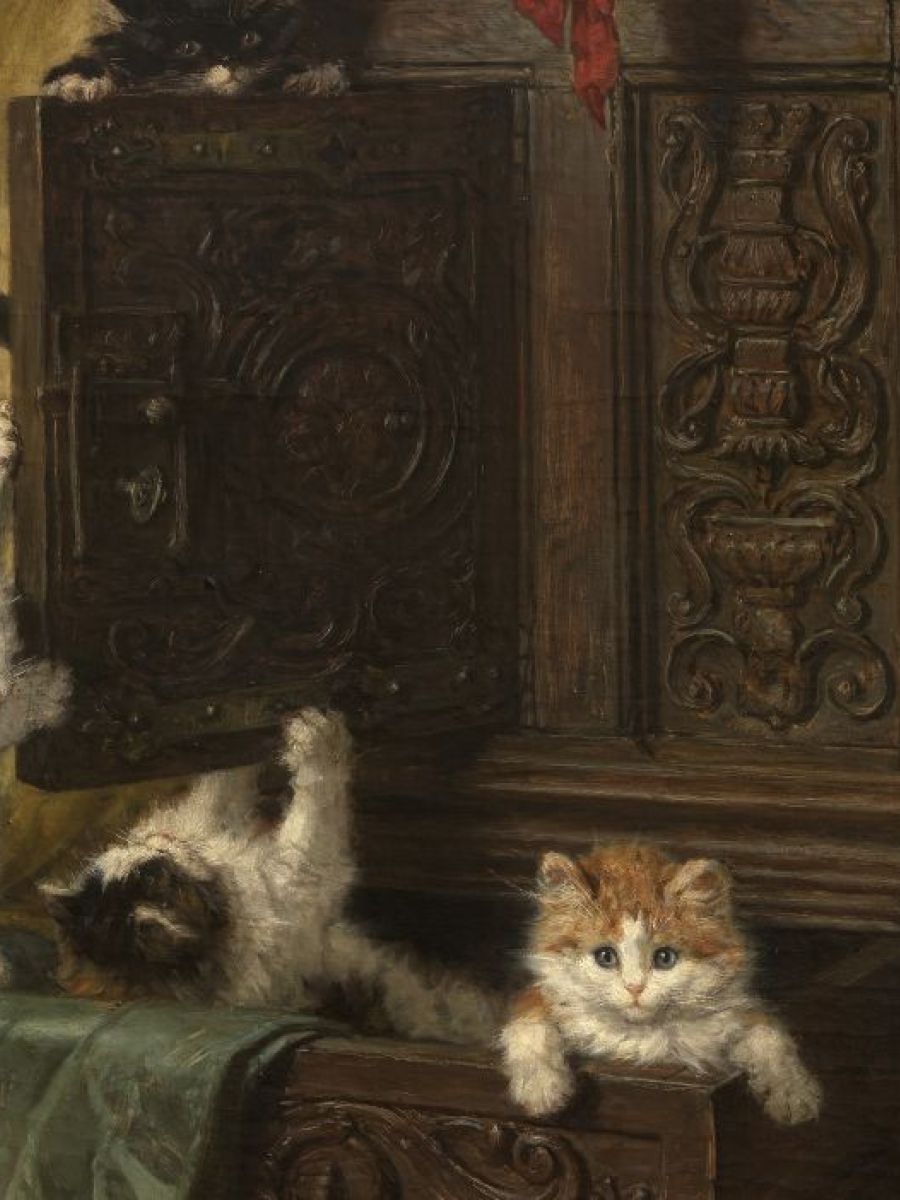
A still life with lively cats full of detail - Misbehaving, Henriëtte Ronner-Knip (1897) (detail)
Life as it is
Indeed, Virginie Demont-Breton (1859–1935) also comes from an artistic family. Her father even married the Ghent-born daughter of his own teacher. Virginie focused on the daily lives of farmers and fishermen. Like a documentary photographer, she captures sensitive snapshots in oil paint. It is no surprise that she accumulated numerous honors, such as medals at the World Exhibitions in Antwerp and Amsterdam. As president of an artists’ association for women, she campaigned for greater female participation in exhibitions and, above all, access to academies to study anatomy. In 1898, the museum acquired not only works by Ronner-Knip but also by Virginie Demont-Breton. Into the Water! depicts a monumentally scaled mother struggling with one of her children, a theme frequently explored by Demont-Breton. Drawn from life, as they say. A year earlier, the artist had triumphed at the Salon in Paris. With this work, the museum can present a Virginie painting at the height of her mastery.
And then there is Adèle Kindt (1804–1884). Just like the kittens and children described above, one of her paintings can be found in the Salon, the large room at the front of the museum. You might have to look closely, as The Fortune Teller hangs quite high. At just 14 years old, Kindt made her Salon debut. From there, her unstoppable rise began. Kindt was versatile and prolific. She exhibited more than 80 paintings at Belgian Salons alone. Historical scenes full of tragedy and portraits were her specialty. And, like Demont-Breton, she was showered with medals. Her own dramatic-romantic style earned appreciation from European royal courts. KMSKA acquired The Fortune Teller in 2001. This work also demonstrates Kindt’s eye for detail and her refined way of rendering textiles tangibly.

Into the Water!, Virginie Demont-Breton

What does the future hold? A comfortable life or a hard one? The fortune teller already knows. - The Fortune Teller, Adèle Kindt (1828) (detail)
KMSKA and Women Artists
Many of the women described here lived long, very long lives. Yet that was no guarantee against falling into the oubliette of art history. Not even contemporary recognition from biographers and royalty, nor the honors and accolades they deserved, could prevent it. Artist and writer Gisela Breitling observed, somewhat pessimistically, that women repeatedly think they are the first, simply because they achieve recognition in their own time. Yet their traces are erased as soon as they disappear from the scene. Will the same happen to Marlene Dumas and Berlinde De Bruyckere?
Together with other museums, KMSKA aims to contribute to the recognition of women. Through the inheritance of collections from the Saint Luke Guild and the Antwerp Academy, their work is less represented in our collection. Thanks to earlier acquisitions and current loans, we can still display masterpieces by women artists. KMSKA has previously made efforts through exhibitions such as Elck zijn waerom. Female Artists in Belgium and the Netherlands 1500–1950 (1999–2000). We aim to continue in this spirit.


