Ensor: painter and writer or writing painter?
In 1928, author, publisher and art critic André De Ridder bombards James Ensor with questions about his views and insights. “I advise you to reread Les Écrits de James Ensor (1921),” the artist replies, “in which I explain my (artistic) quest and defend my ideas.” He is referring to a publication that De Ridder himself had edited.
Ensor’s literary writings are all too often ignored. “Nothing more than the signs of a waning creativity,” wrote Lydia Schoonbaert, an eminent Ensor scholar and chief curator of the KMSKA Antwerp from 1984 to 1995.
At times—especially in his younger years—Ensor himself also doubts his ‘literary’ abilities. In old age he occasionally describes himself modestly as “a writer in his spare moments.” Yet even as an insecure young man he insists that his texts be published unchanged. Later in life he takes great pleasure in railing against:
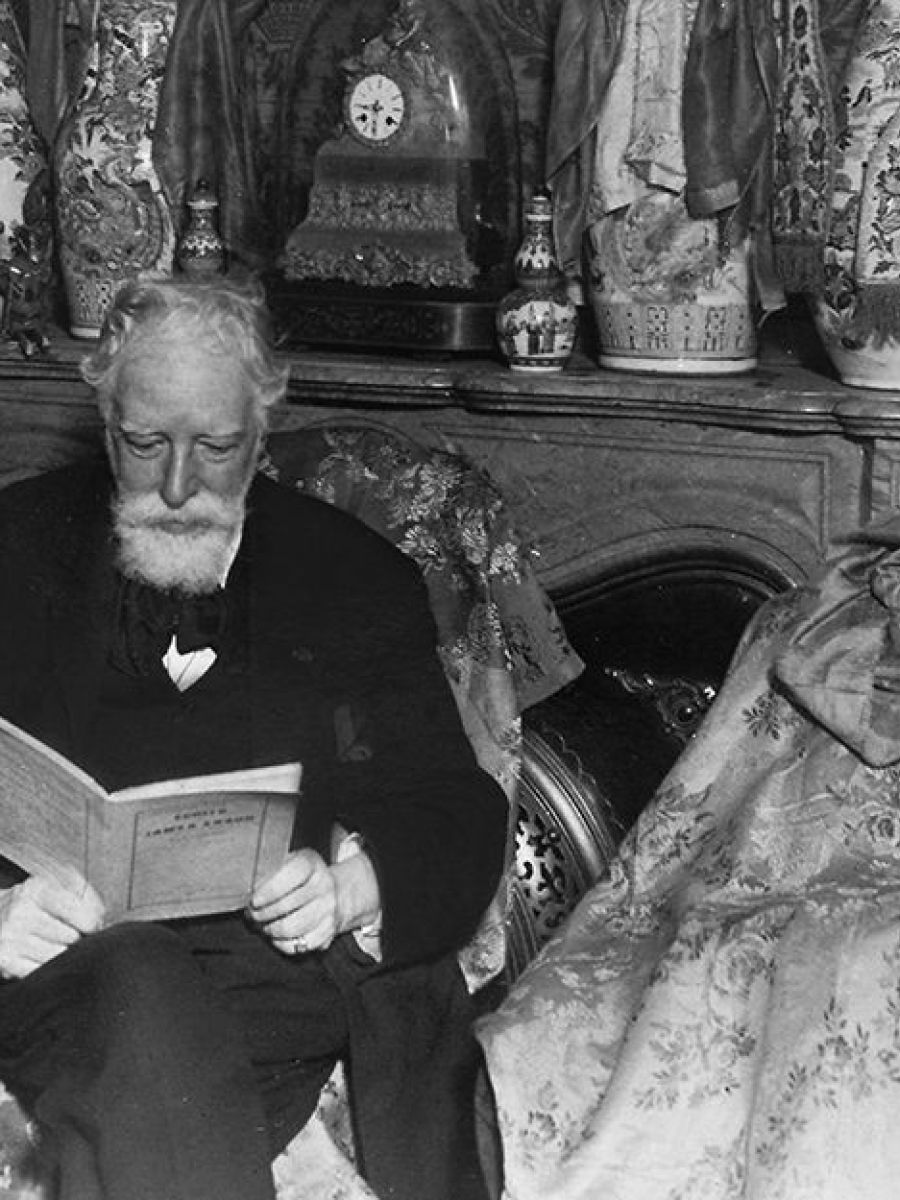
“Sun-eclipsed painters, living riddles who laugh forever green. / Paint, always paint. Never write, cautiously suggest the worthy finger-snapping reasoners, who with utmost correctness babble the most unfathomable nonsense. Long live the ignorant and supremely naïve painter! (…) Salute, salute, long live the peasant in art proclaim the feather-light, credulous goslings, and it is a fact: the blossoming of the deeply saddened peasant, in wide breeches, is the order of the day. It is Flemish art and truly, our champions of the (paint) splatters labour in vain. I, I bow to the great figures of all times, sensitive and clairvoyant minds who at the same time were great painters, musicians, writers, poets and sometimes inventors and scholars, and who by no means degenerated.”
Monologue with complications
Ensor wrote hundreds of businesslike and often concise letters to family members, friends, acquaintances and clients. In 1884 he made his literary debut in the avant-garde journal L’Art moderne with a more or less fictional theatre text in which he mocks the professors at the Brussels Academy of Fine Arts. It was titled: Three Weeks at the Academy. A Monologue with Complications.
From 1896 onwards, Ensor would repeatedly publish short pieces in the Brussels anarchist-leaning journals Le coq rouge and La ligue artistique: libre tribune d’art et de littérature. Somewhat later he occasionally wrote for newspapers published in Ostend and for the liberal satirical magazine Pourquoi pas? In 1921, André De Ridder was responsible for the publication of a first selection of 24 texts by the Brussels avant-garde gallery Sélection.

Original manuscript - The archives of the KMSKA preserve quite a number of original manuscripts for Ensor’s publications.

Original manuscript
New editions of Ensor’s writings appeared in 1926, 1934 and 1944. The archives of the KMSKA preserve quite a number of original manuscripts for these editions. After Ensor’s death, three French-language editions and one Dutch translation were published – the latter is usable, but the translator did not take enough liberty to do justice to Ensor’s meaningful double entendres. To this day, there is still no complete edition of all the artist’s writings.
Bluff, amaze, overawe
In addition to satirical articles, Ensor also wrote numerous occasional speeches. From the 1890s onwards, his wildly eccentric and provocative addresses became notorious in Brussels literary circles. Ensor’s texts and speeches are rarely clearly structured. Piles of qualifications, litanies, tirades, bawdy jokes, assonances, alliterations, rhymes, puns, archaic terms, contrived words, substantivized adjectives and adjectivized nouns often make the content difficult to grasp. Even as a writer, Ensor loved to bluff, amaze, and overawe.
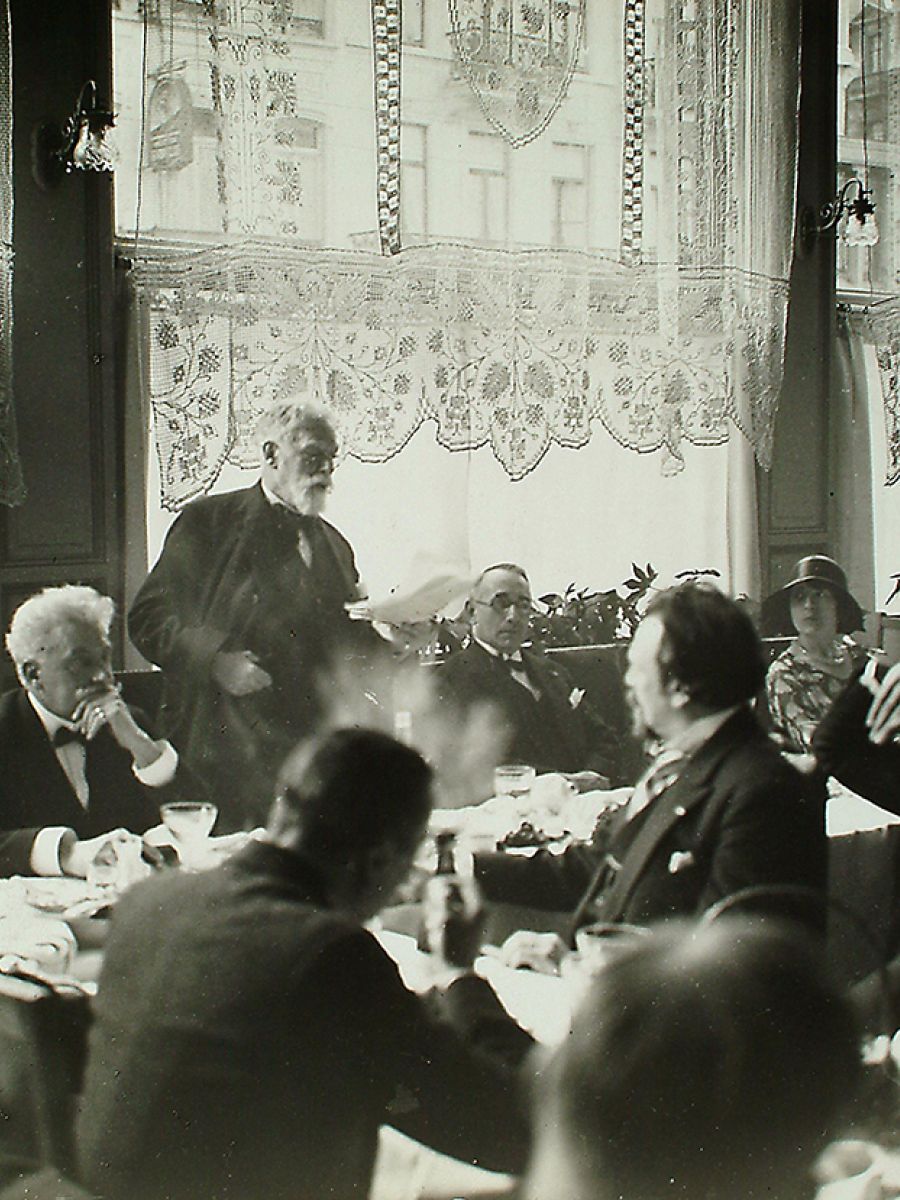
Wildly mad discourse - From the 1890s onwards, Ensor’s wildly eccentric and provocative speeches were notorious in Brussels. Photo: KMSKA Archives.
Slam poetry
Ensor’s friend, the poet and critic Émile Verhaeren, compared Ensor’s expositions to an uncorked bottle of champagne and coined the term superlificoquentieux for his literary language, which could perhaps best be translated as “wondrously remarkable.”
More recently, the Irish literary historian Claire Moran compared Ensor’s unique literary style to slam poetry. Ensor’s texts are most enjoyable when read aloud. Nevertheless, some of his works have been included in anthologies such as La Belgique artistique et littéraire (1997) and Fumisteries. Naissance de l’humour moderne (2011).
Ensor’s texts are most enjoyable when read aloud.
Joie de vivre
Enjoying Ensor’s texts is one thing. His writings also constitute a neglected but indispensable source for understanding his vision of the world, humanity, and art. From the outset, he refuses to be “an ignorant and supremely naïve painter.” He does not believe in a deity or an afterlife—religion is at most amusing. Nor does he place faith in the benefits of science. In the pursuit of a single blissful moment, it is not reason but feeling that is crucial. Ensor’s writings often bear witness to his joie de vivre.
In 1925 he paid tribute to the subjects that his friend Henry Cassiers had depicted in hundreds of illustrations: the turbulent North Sea, Zeeland, and the beautiful girls of Zeeland.
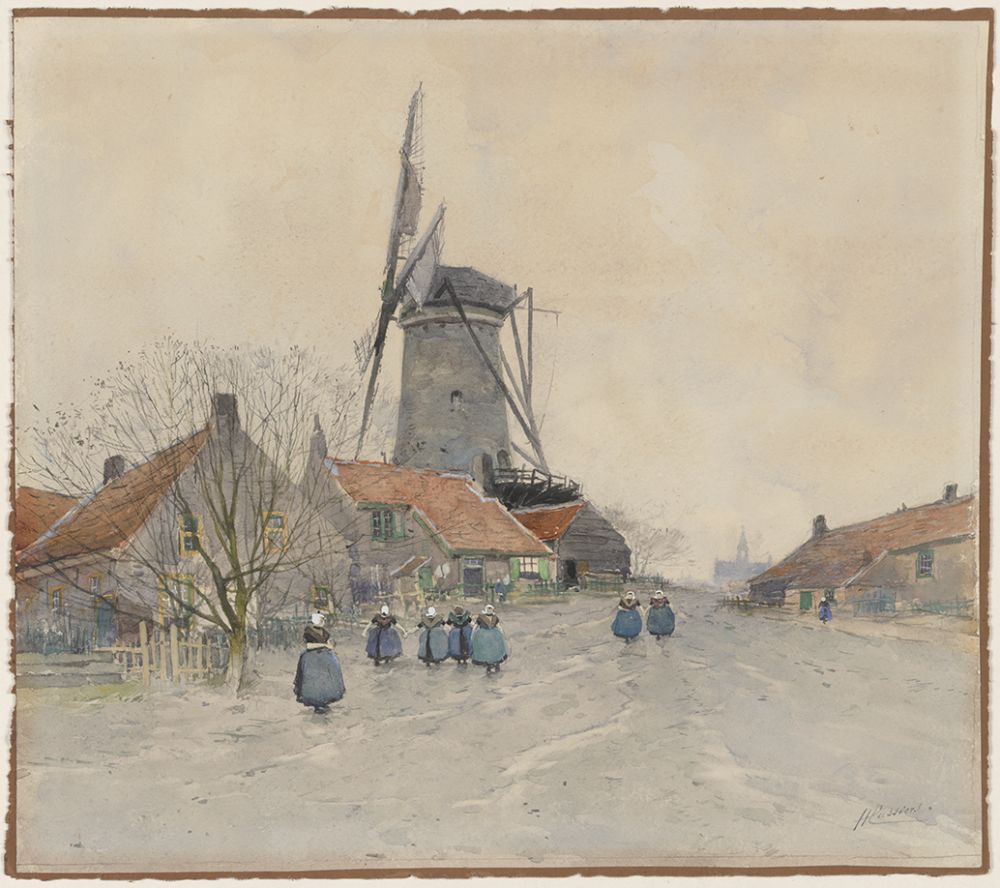
In Axel - Henry Cassies, KMSKA
“Let us praise their charms and their finery, their delightfully narrow upper forms. Enchanting inverted chalices—the flaring lower parts of earthenware frigates laden with velvet tulips: skirts of antique silk, the clatter of lacquered and flower-decorated clogs, a yellow-brass cap reflecting the golden sun, vermilion-red chain links, turquoise rings adorned with topaz, sparkling scarves with quicksilver pins, modestly draped; the small hidden forehead of a stubborn mule. (…) They smell of fine cinnamon, cloves, and oranges, pepper and almond cookies, dried plaice, cheese with anise. (…) Thanks to you, dear Cassiers, the whole world knows beautiful Holland, its meadows, its flowers, its cows, and its windmills. (…) There, people love nature, they honor the dunes, the crystal-clear canals, the emerald dikes.”
Sweet land of golden butter
In his art and writings, Ensor repeatedly exposes human weakness and malice. Although he was friends with socialist politicians such as Edmond Picard, Jules Destrée, and August Vermeylen, he remains “ideologically” neutral in his writings. Yet when it comes to denouncing the “atrocities of vivisectors” or the destruction of cultural monuments and nature, he attacks with full force.
“…our vast milky skies, our rains, our seas, our Flemish fields where the gray earth hides itself, astonished, beneath the leaves and flowers. Sweet land of golden butter, silver lacework, singing reeds—you call us to the righteous struggle to defend our docks, where slender then stocky boats proudly glide and the rainbow-marbled tide adorns (…) muddy peddlers from the Ugly Realms dare, in the name of fragile progress, to conspire to drain your sources of eternal beauty (…) Babbling, chatter-prone engineers, pale, fumbling, voiceless, cacophonous, rickety traders. Unhatched retina-breakers with your extinguished eyes (…) your misshapen projects pile up. Voracious rippers of our pristine places. Unmatched violators. Deformed, blunt surveyors. Desperate, muzzled architects—your outdated blocks make us recoil.”
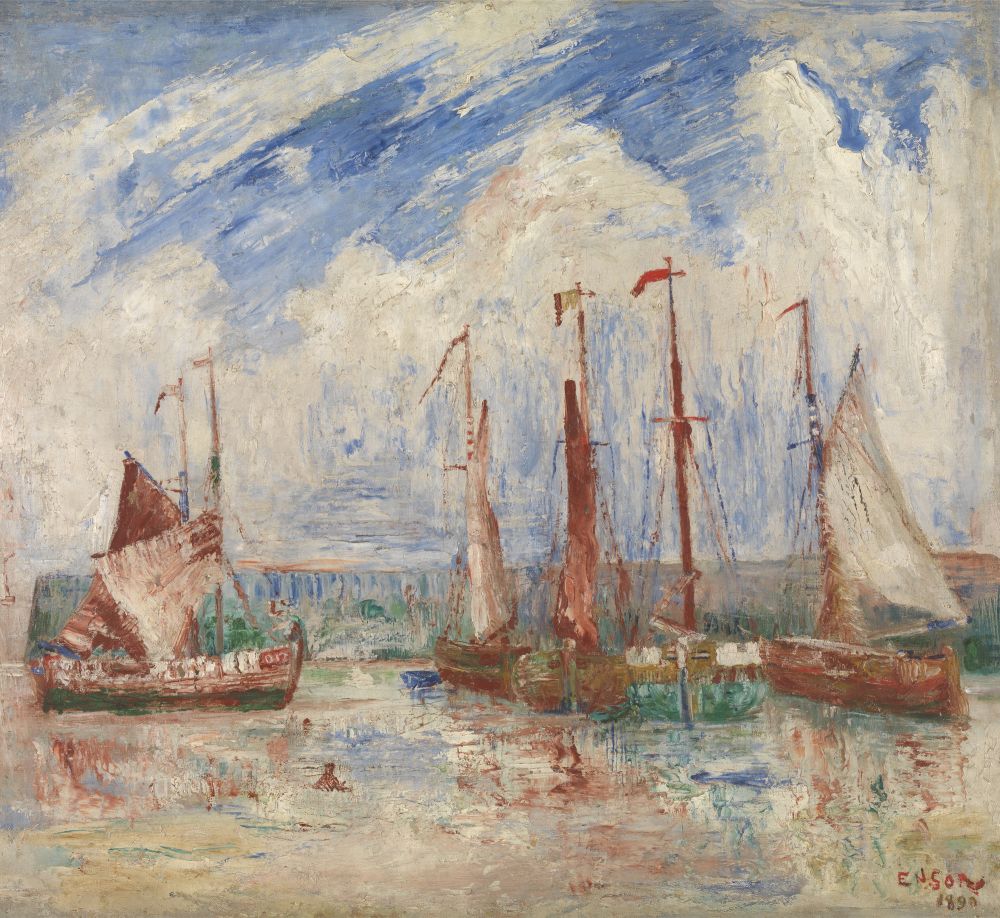
Sloops - James Ensor, KMSKA
The endurance of Isabella (with the dirty underwear)
“Lady Color, my great friend, beckons me—yes indeed, madam, color is the sweetheart of the true painter; she explains all my (artistic) developments, my changing ways of painting. In the past, people said: ‘Ensor changes style as often as his shirt,’ and then I envied Isabella (archduchess), inspiratrice of our Flemish masters, for her endurance. Yes, despite the times, our modern colorists undergo the influence of Rubens’ little friend. I, I prefer the roses and their scale of purity. Painting is color, and I value far less the dead language, the hardened line, the gray pallor, and the tones stripped of their freshness by the brush monkeys. I mix my colors in clear weather, with open visor, proud gaze, raised hand, palette loaded, paint tubes burst open, brush at the ready. Ladies with poorly applied colors battle each other to the utmost, like troublesome, dreadful neighbors. The endless war between the two roses continues. Miss Vermilion glares at Madame Lead White, Madame Chinese Lac blushes for Mister Dextrine Blue, and when Miss Bitumen leaks from the (oil) source, Mister Cadmium transforms into a canary. Over trivial matters, the Greens become tipsy grays or develop little blues. Madam English Red and Mister Carmine neutralize each other completely.”
The publication James Ensor, Occasional Modernist. Ensor’s Artistic and Social Ideas and the Interpretation of His Art (2019) explains why Ensor enjoyed portraying Archduchess Isabella. She reportedly refused to change her underwear as long as Ostend remained a Protestant stronghold (from 1601 to 1604). It also explains why he referred to the conflict between the houses of York and Lancaster, which used the white and red rose as their respective symbols. Finally, he admits that he liked to use cadmium yellow, a pigment we now know is not always entirely reliable.


