Zeldzaam &
Onmisbaar

Under the title Zeldzaam & Onmisbaar, you can see 100 works from the Flemish Top Pieces List brought together at the MAS in Antwerp from 31 October 2023 to 25 February 2024. In this way, the Flemish Top Pieces Decree celebrates its twentieth anniversary.
An indispensable Top Piece possesses one or more of these four characteristics: it has a linking function, a special value for the collective memory, a benchmark value and/or a particular artistic value. We use these characteristics as a guideline to highlight four of our Top Pieces.

The linking function | The Two Springs
Gustave Van de Woestyne (1881–1947) writes about this work in 1915:
“My painting ‘The Two Springs’ depicts two young girls: one is from the countryside wearing a red bodice, and the other is from the city with a large hat, adorned with a large red feather on her head.”
Van de Woestyne is enchanted by the landscape around Sint-Martens-Latem and its simple agricultural life. In this painting, he makes no secret of his preference for the unadorned farm girl. He almost completely hides the city girl beneath her gigantic hat.
Gustave Van de Woestyne closely studies his predecessors and arrives at this idiosyncratic blend of Flemish and Italian Renaissance elements, wrapped in a modern visual language. Like the Italian artists before him, he fills the pictorial space completely with his monumental figures. Yet he gives his so-called country mouse and city mouse very little room to move. Madonna del Parto (1455–1465) by Piero della Francesca seems to have lingered somewhere in the back of his mind. The farm girl appears almost like a mirror image of the Madonna, with her slender neck and the opening in her dress. From Hans Memling and Jan van Eyck he adopts elements such as the three-quarter profile, clear contours, and the glimpse of a landscape with a tiny farmer in the distance.
Despite their contrasts, Van de Woestyne also connects the women. Through the red areas, their matching posture, a curled lock of hair by the ear, and the shape of their mouths. All these elements contribute to the balanced composition.

Palm tree from 'Bernardo Bembo, statesman and ambassador of Venice' - Hans Memling, KMSKA

Madonna del Parto - Piero della Francesca
From Memling and Van Eyck he adopts elements such as the three-quarter profile, clear contours, and the glimpse of a landscape with a tiny farmer. Van de Woestyne transforms the Italian and Flemish art traditions into a powerful image, where the prominent color areas almost—but not quite—become abstract. The little landscape is a fragment of Memling’s Bernardo Bembo, also a Top Piece.
2. The collective memory | The Mad Violence
The Mad Violence is one of the best-known sculptures by Rik Wouters (1882–1916). The version from the KMSKA collection is exuberantly displayed at the Middelheimmuseum. The open-air sculpture park seems like the perfect setting for this burst of energy. From the bronze belly, the energy pulses in all directions, culminating in a total release of accumulated force.
Only Wouters’ wife, Nel, had to pose stiffly on one leg for hours for this creation. That in itself was an achievement—a testament to Wouters’ skill in balancing the sculpture on a single support point without it toppling over.
Wouters found the inspiration for this unusual approach in the American dancer Isadora Duncan. In 1907, he sees Duncan working in Brussels together with Nel, performing her Scythian Dance, based on antique depictions of dancing bacchantes. The artist let his ideas mature until, in 1912, he created The Mad Violence as a kind of condensed memory of Duncan’s wild dance.
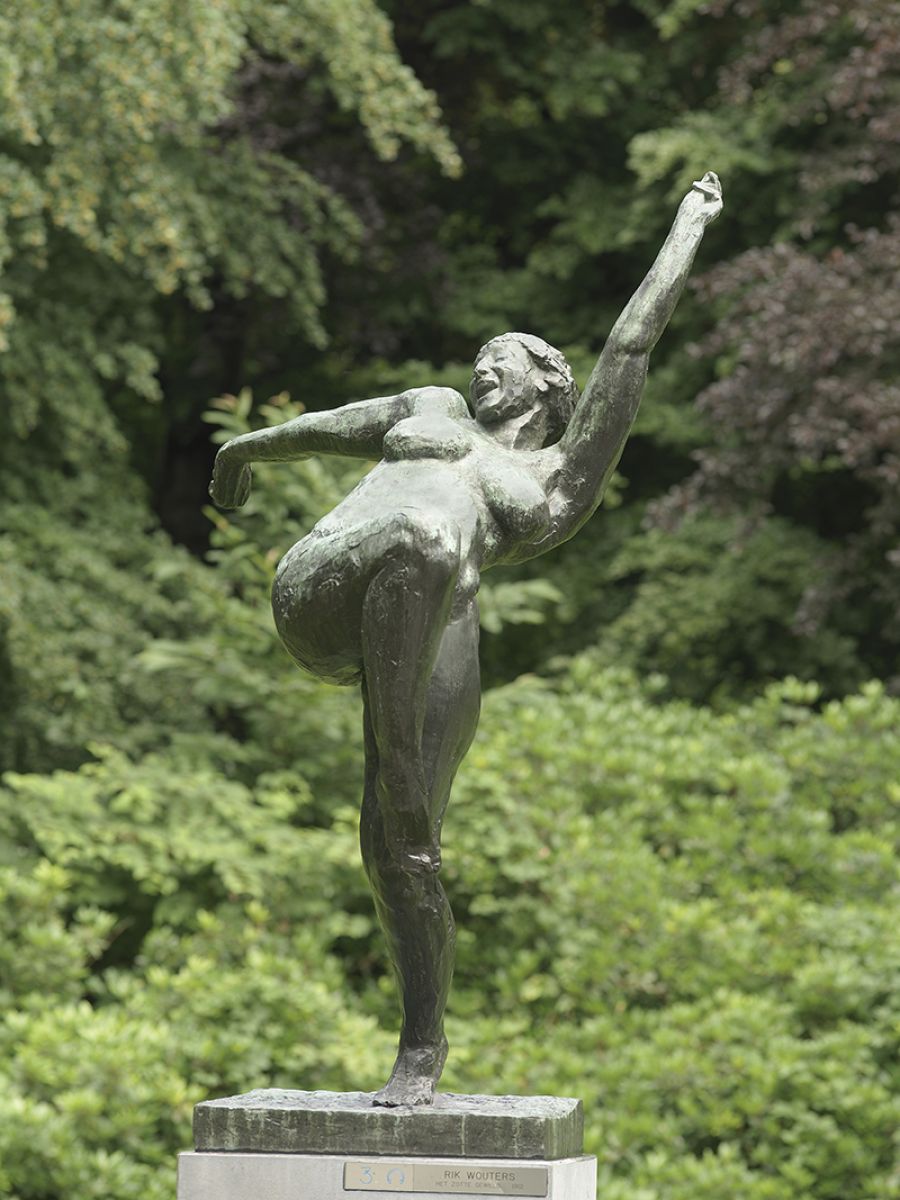
The Mad Violence - Rik Wouters, Middelheimmuseum
Besides being technically complex, the sculpture also reveals a clear choice: lifting the leg was not exactly the most modest option for a nude. Nel’s forms are as realistic as they are sketch-like. While realism was at its peak in painting, it was not as self-evident in the sculpture of the turn of the century. Rik Wouters therefore studies the innovator Auguste Rodin (1840–1917) closely. Both seek unconventional forms. And ultimately, The Mad Violence is exactly that: an extremely original creation composed of forms. Nel’s nudity does not matter. As in architecture the phrase form follows function resonates, here one could say: form follows concept.
3. The benchmark value | Self-Portrait during a Lion Hunt
Somewhere between 1879 and 1885, James Ensor (1860–1949) made this sketch (or sketches). As the title indicates, the young artist studied his own face. As is often the case, artists do not necessarily fill a sketch sheet with only one subject. Ensor therefore adds a lion hunt to his own head, reminiscent of those by Peter Paul Rubens (1577–1640) or Eugène Delacroix (1798–1863). By placing the two on one sheet, the horse and rider and the lion appear as a dreamlike image from Ensor’s mind. Like in a comic strip.

Self-Portrait during a Lion Hunt - James Ensor
Top Pieces with benchmark value make an important contribution to research. For an art museum, artists’ original sketches are like real treasure maps. Under the banner of the Ensor Research Project, the KMSKA studies Ensor’s creative process. This is no coincidence: the museum holds the most extensive Ensor collection in the world. It includes, among other things, 38 paintings and 675 drawings and sketches. The majority of these drawings are recognised as Top Pieces, like this self-portrait. These 675 drawings bring us very close to Ensor—showing how he sharpened his talent, searched for compositions, and evolved as an artist. Through drawn copies, we can see which artists he himself regarded as models, and how he combined reality and visions in sketches day after day.
Drawings are fragile and cannot withstand much light, so we rarely exhibit them. Self-Portrait during a Lion Hunt is stored in specially adapted storage cabinets. In the Ensor wing of the KMSKA, there is a print cabinet where prints and drawings are rotated every three months. You might one day see this drawing there in person.

4. The particular artistic value | Still Life with Fish
Clara Peeters (ca. 1588–ca. 1657) is without a doubt one of the heavyweights in Western art history. She is the queen of still life. In the early seventeenth century, this genre began to rise in popularity. Shifts in religious practice changed the tastes of citizens who could afford a painting. The everyday started to enter the art world.
Still lifes, however, did not score very high on the appreciation scale. The world considered imagined scenes to be the true masterpieces, because the artist had to use their imagination to invent them. Still lifes, with the subject right in front of you, were therefore a safe genre for ladies who wanted to play with paint.
That may be true. But that Peeters discarded the idealising visual language of her time and started painting hyperrealistic household objects is avant-garde. It was Peeters who first began adding fish, and it was Peeters who placed hunted animals on the table for the first time. All very precise—every surface and texture carefully rendered. And she earned a good living from it. Her work was even coveted in Spain.
Unfortunately, Clara Peeters suffered the same fate as many other female artists. Despite great successes during her lifetime, she was later forgotten. Fortunately, in 1905 the museum was able to acquire Still Life with Fish, one of her 39 known works. This allows us to keep the legacy of this pioneer alive.
Exhibition Zeldzaam & Onmisbaar
From 31 October 2023 to 25 February 2024, 100 works from the Flemish Top Pieces List at the MAS in Antwerp.


