Ensor dissected to the core

With 39 paintings and over six hundred drawings, the KMSKA holds the largest James Ensor collection in the world. Through the Ensor Research Project, the museum also aims to become the main reference center for research on the Belgian modernist. The project is led by Ensor specialist Herwig Todts, KMSKA curator of modern art, and Annelies Rios-Casier, a master’s graduate in conservation and restoration. She is affiliated with both the KMSKA and the University of Antwerp (UA) as a researcher and is preparing a doctoral dissertation on Ensor.
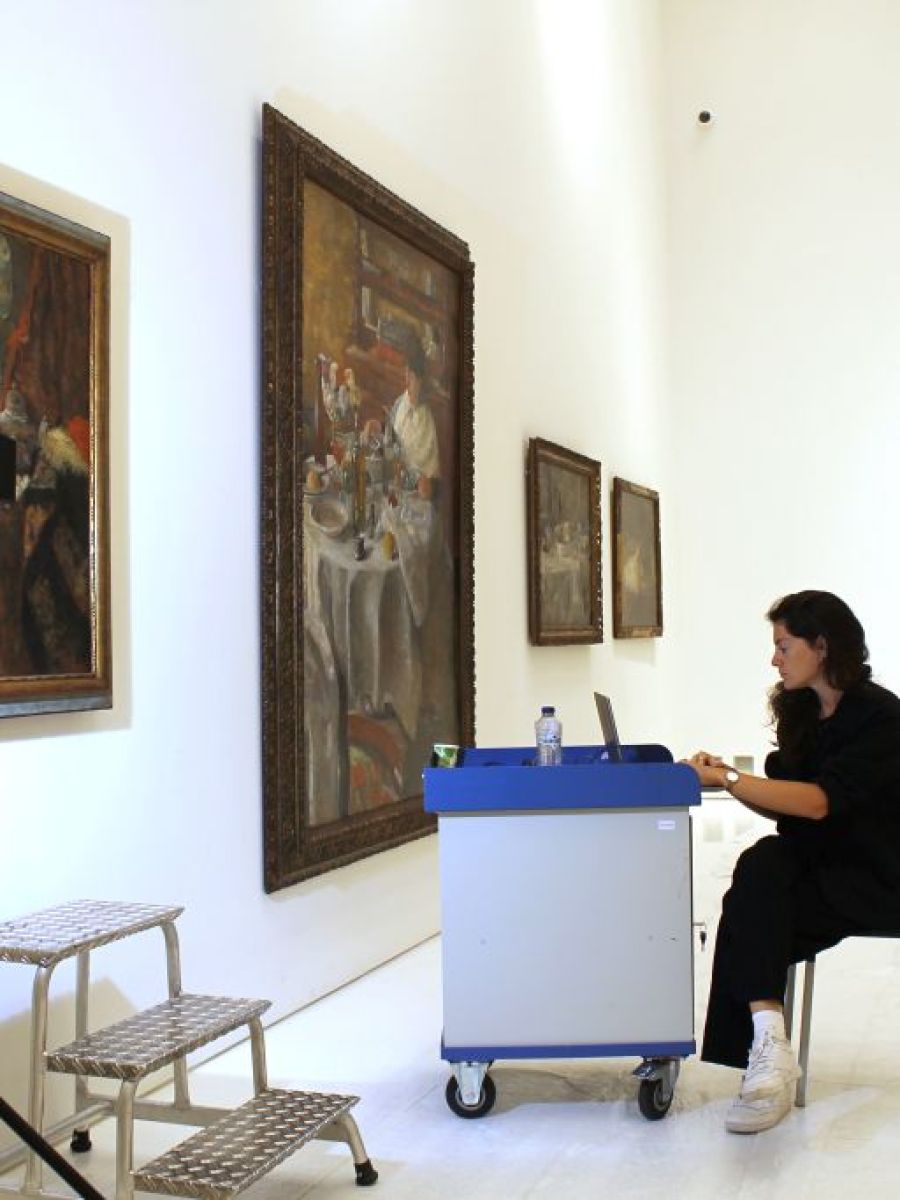
Annelies Rios-Casier analyzes Still Life with Chinoiseries in Gallery 1.1, Ensor.
What is the Ensor Research Project?
Herwig Todts: “We study the creative process: where does Ensor start, and where does he end up? How does a composition come together? On one hand, this is classical art-historical, stylistic research—what are the sources, what studies and designs exist?—and on the other hand, it is material-technical research of the object itself using techniques that have often existed for a long time, such as X-rays and infrared, but which have been significantly improved over the last twenty to thirty years. This research allows us to see exactly what the artist did: step by step, from the initial idea to the final result. In doing so, we examine the underdrawing, the brushwork, the varnish layer, and even the framing, whether or not it is behind glass. Ensor was involved in these details as well, as correspondence shows.”
Why did you choose Ensor?
Herwig: “He belongs to that small group of internationally important Belgian artists of the 19th and 20th centuries: Paul Delvaux, René Magritte, Pierre Alechinsky, and James Ensor. Ensor is the most important Belgian modern artist because he is an innovator, making the shift from a realistic depiction of reality to a modernist approach, in which he freely uses light, color, and form. He does not take the step into abstraction, but he constantly experiments: he explores all the new paths that 20th-century art would follow without consistently pursuing a single direction, as Matisse or Picasso did. Ensor’s innovations make the study of his creative process so fascinating.”
Ensor explores all the new paths that 20th-century art would take without consistently following a single direction.
What have you learned so far?
Annelies Rios-Casier: “We now know more about Ensor’s technique and pigment use, as well as about degradation phenomena and overpainting.”
Herwig: “We focus specifically on Ensor’s painting. One thing we’ve learned is that Ensor made few preliminary studies, but he often reused and adapted existing compositions: his own or those of others. For example, The Skeleton Painter is based on a photo of Ensor in his studio. On a small panel, he made a drawing, and when he painted it, he transformed his own head into a skull.”
“Most of his compositions are very simple. Take The Bourgeois Salon, for instance. For more complex compositions, he did make preparatory studies: often etchings or drawings with many figures, like The Baths of Ostend, where he could not improvise.”
“Ensor was long said to have used very poor-quality materials:The Entry of Christ was supposedly painted with house paint. That is completely false: he used expensive paints and canvases, materials he purchased from suppliers like Blockx, which also supplied Monet. People also claimed that Ensor worked completely improvisationally, as a kind of expressionist, surrealist, or informal Cobra artist avant la lettre. That’s not true either. Take The Fall of the Rebel Angels: he certainly prepared that painting, because it’s complex. He didn’t just mess around, like Karel Appel once said about himself.” (laughs)
We now know more about Ensor’s technique and pigment use, as well as about degradation phenomena and overpainting.
Do you work chronologically?
Annelies: “Not really. We’ve listed twelve key works that we’re going to examine from a material-technical perspective: among them The Entry of Christ, The Oyster Eater, and Skeletons in the Studio. These works are representative of certain periods in Ensor’s oeuvre. It doesn’t make much sense to work strictly chronologically, because Ensor used different techniques and styles simultaneously.”
Herwig: “Music in Vlaanderenstraat and The Intrigue were painted almost at the same time [1891 and 1890, respectively; ER]. Yet they are completely different works: one is a naïve piece in the style of Le Douanier Rousseau, while the other, with some exaggeration, could be by Nolde.”
Annelies: “Because Ensor experimented so much, it’s difficult to divide his work into strict periods. That’s why we now look at groups with a selected core work in each: early work, plein-air work, the masks, more impressionistic pieces, and the grotesques. I’m now examining these twelve key works for possible developments in materials and technique. These are pivot points, around which I bring together other works to see if I can extrapolate my findings.”
“So far, I’ve observed that Ensor’s early, academic work is very classically painted, with the typical build-up of multiple paint layers. He maintained this method until he began working on the masks. After that, he abandoned the layering. His pigment use also changed: the early work is darker, as he mixed his paints, whereas later he applied them pure, using lighter pigments. In The Intrigue, there is an underpainting which he then colors, placing the colors side by side.”
Herwig: “Ensor saw Monet and Renoir in 1886. That’s the key. The Impressionists showed him how to place colors next to each other on an unprimed white canvas. After that, Ensor moved toward large color planes, as in The Intrigue. Monet was not doing that at the time.”
You have equipment that can tell us much more than before.
Annelies: “At the KMSKA, we can create UV, infrared, and X-ray images. In collaboration with the University of Antwerp, we examine the paint layers using two scanners. The Macro-XRF scanner detects the distribution of elements in the paint layer, but it also reveals more about overpainting and adjustments. The Macro-XRPD scanner provides detailed information about the pigments used. The two techniques complement each other.”
Herwig: “With infrared, we find all carbon-based materials, such as pencil underdrawings; with X-rays, we can see overpainting or compositional changes; and UV tells us more about the surface, old restorations, and varnish… You have to piece all the results together like a puzzle to get a complete picture.”
This article previously appeared in ZAAL Z. Four times a year, ZAAL Z takes you into the world of the KMSKA and its collection, with inspiring interviews, engaging in-depth articles, and fun news. For just €35, you receive a year of detailed insights into the KMSKA, its collection, and its operations.


