Le coup de lance, by Rubens?

BY NICO VAN HOUT
Le coup de lance is a famous painting from the KMSKA collection. Among others, Sir Joshua Reynolds and Eugène Delacroix expressed their admiration for it. For several centuries it has been known as a masterpiece by Rubens. Yet the preparatory studies for this altarpiece do not seem to be the work of the great master.
Various old sources point to Rubens as the author. A 17th-century print by Schelte Adamsz. Bolswert reproducing the painting bears the inscription ‘P.P. Rubens Pinxit’: ‘Rubens painted it’. And in his biography of Rubens, Gian Pietro Bellori praised Le coup de lance in 1672 as a work by the master.
Hardly to be surpassed
In 1727 Antoon Sanders (in Latin: Sanderus) visited the Minderbroederskerk in Antwerp, today largely demolished, where the painting was located in the high altar. On the pedestal of the portico he read an inscription in Latin. In translation it reads: ‘In the year 1620 after the Birth, Nicolaas Rockox […] erected this high altar, a splendid work in various kinds of marble. The painting in it shows with rare artistry the crucified Christ between the two thieves. Rubens painted it in such a way that he would hardly surpass himself.’ Beneath the painting itself he read: ‘Mayor Rockox erected this altar for Christ. The painting was made by the hand of Rubens. Whether one looks at the craftsmanship of the artist, or at the heart of the donor, nothing could have been given with a nobler spirit.'

Christ on the Cross with Saint Mary Magdalene - Anthony van Dyck, The Courtauld

Le coup de lance - Here attributed to Anthony van Dyck, Victoria and Albert Museum
Moving on to Van Dyck
En toch. Al in de negentiende eeuw betwistten kunstkenners de toeschrijving aan Rubens. In Les maîtres d’autrefois uit 1876 omschreef Eugène Fromentin De lanssteek als een onsamenhangend werk. Het bestaat volgens hem uit afzonderlijke fragmenten die weliswaar elk het idee van Rubens’ mooiste verwezenlijkingen in zich dragen. Max Rooses (1888), Rudolf Oldenbourg (1922) en Gustav Glück (1931) schreven het schilderij toe aan Anthony van Dyck. Zo ontstond tussen kunsthistorici een diepe controverse tussen believers en non-believers. Feit is: enkele voorbereidende studies voor het altaarstuk dragen het stempel van Rubens’ jonge medewerker, zoals de snelle krabbelingen voor De lanssteek (Museum Boijmans van Beuningen, Rotterdam) en een penschets van de Christusfiguur en de smekende Maria Magdalena (Courtauld Institute, Londen). Die tweede studie ontdekten we op de achterkant van een blad waarop Van Dyck enkele bomen tekende. Nog belangrijker is dat de monochrome olieverfschets van de volledige compositie (Victoria and Albert Museum, Londen) sterk van Rubens’ olieverfschetsen verschilt. De dunne nerveuze penseellijntjes in dit modello lijken veeleer op de summiere, haast bibberige verfhoogsels die we in latere olieverfschetsen van Van Dyck aantreffen, zoals op de schets voor de Heilige Augustinus van Hippo in extase in het KMSKA (inv.nr. 5145).
And yet. Already in the nineteenth century, art experts questioned the attribution to Rubens. In Les maîtres d’autrefois from 1876, Eugène Fromentin described Le coup de lance as an incoherent work. According to him, it consists of separate fragments, each of which nevertheless carries the idea of Rubens’ finest achievements. Max Rooses (1888), Rudolf Oldenbourg (1922), and Gustav Glück (1931) attributed the painting to Anthony van Dyck. This gave rise to a deep controversy among art historians between believers and non-believers. The fact is: some preparatory studies for the altarpiece bear the mark of Rubens’ young assistant, such as the quick sketches for Le coup de lance (Museum Boijmans van Beuningen, Rotterdam) and a pencil study of the Christ figure and the pleading Mary Magdalene (Courtauld Institute, London). That second study was discovered on the back of a sheet on which Van Dyck had drawn a few trees. Even more importantly, the monochrome oil sketch of the full composition (Victoria and Albert Museum, London) differs significantly from Rubens’ oil sketches. The thin, nervous brushstrokes in this modello resemble more the sparse, almost shaky paint touches found in later oil sketches by Van Dyck, such as the sketch for Saint Augustine in Ecstasy in the KMSKA (inv. no. 5145).
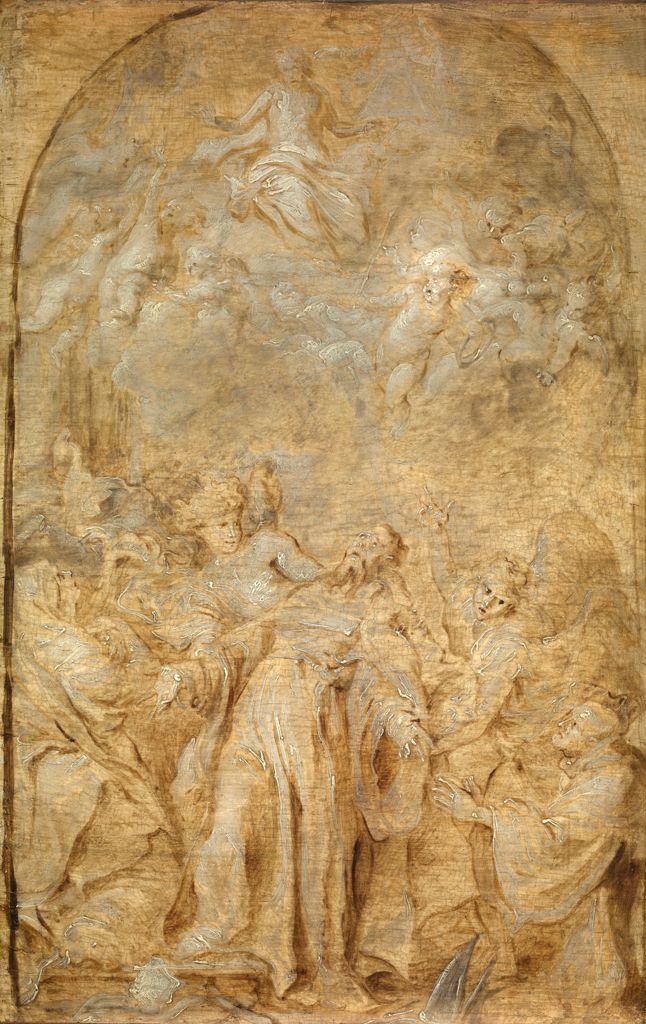
Saint Augustine in Ecstasy - Anthony van Dyck, KMSKA
Rubens’ employer
For the project, Rubens made a figure study of a man with a ladder who was not included in the painting (Vienna, Albertina), but that does not change the fundamental role his assistant played. From all of this, we conclude that Van Dyck was responsible for the design of Le coup de lance. A thorough study of the large panel in 2011 showed that the altarpiece, alongside weaker passages, also contains sublime moments, such as the face of Mary Magdalene or the two spectators in the background.
The young Anthony van Dyck painted Le coup de lance for his employer, the Rubens workshop. So the truth is not always set in stone. From now on, the altarpiece in the KMSKA will bear the name of Rubens’ right-hand man.
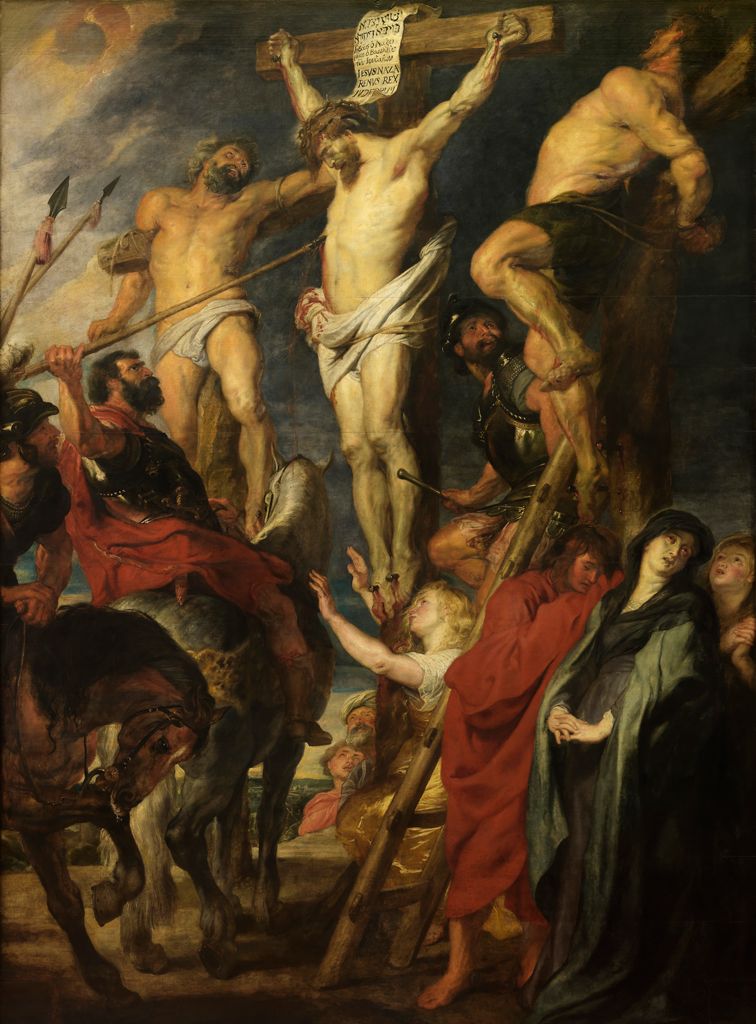
Christ on the Cross, 'Le coup de lance' - Anthony van Dyck, KMSKA


