Sport and play

Almost the Olympic Games in Paris. What does the KMSKA collection have to say about sport and play?
This is part of an article in ZAAL Z, the museum magazine. Want to read the full article? Subscribe now for just €35 and receive four issues.
Wrestling Barrack at a Fair
In this 1898 painting by Henri Evenepoel (1872–1899), tension is carefully built. We see two wrestlers—not yet in combat, but mere moments before their duel. One man is taking off his shirt, while the other is busy loosening his shoes. Instead of depicting a dramatic fight, Evenepoel chooses to focus on the “small” moments just before the confrontation. This aligns with his aim to portray real, unfiltered life as a peintre de la vie moderne. Anything could still happen: which of the two men will emerge victorious? The audience at the Paris fair watches with eager anticipation from the sidelines. The colors are restrained, except for the intense red of the backdrop behind the wrestlers, echoed in the waistband of the seated man’s trousers and the clothing of the spectators. None other than the color master Henri Matisse praised Evenepoel for his “extraordinary coloristic talent.”
Work in header: Henri Evenepoel, Wrestling Barrack at a Fair, KMSKA
The Oarsmen
In a whirlwind of cutting planes and shapes, Jos Leonard (1892–1957) depicts a dynamic scene of rowers. Due to the rather abstract rendering, they may not be immediately recognizable, but careful observation reveals several boats seen from side and top perspectives. Near the center of the painting, a highly simplified face appears. The artist does not aim to capture a single snapshot; Leonard conveys the passage of time and offers multiple viewpoints from which to observe the rowers. The rhythm of the sharp lines and undulating forms creates a sense of movement, influenced by Italian futurism.
Jos Leonard was one of the first non-figurative artists in Belgium. He co-founded the Kring Moderne Kunst to promote the Belgian avant-garde. By experimenting with shapes, colors, and lines, these artists went beyond mere depictions of strictly observable reality. In this 1919 work, Leonard simultaneously shows multiple perspectives and conveys motion through repeating lines and fragmented planes. This approach perfectly reflects the chaos of the rapidly changing modern era.
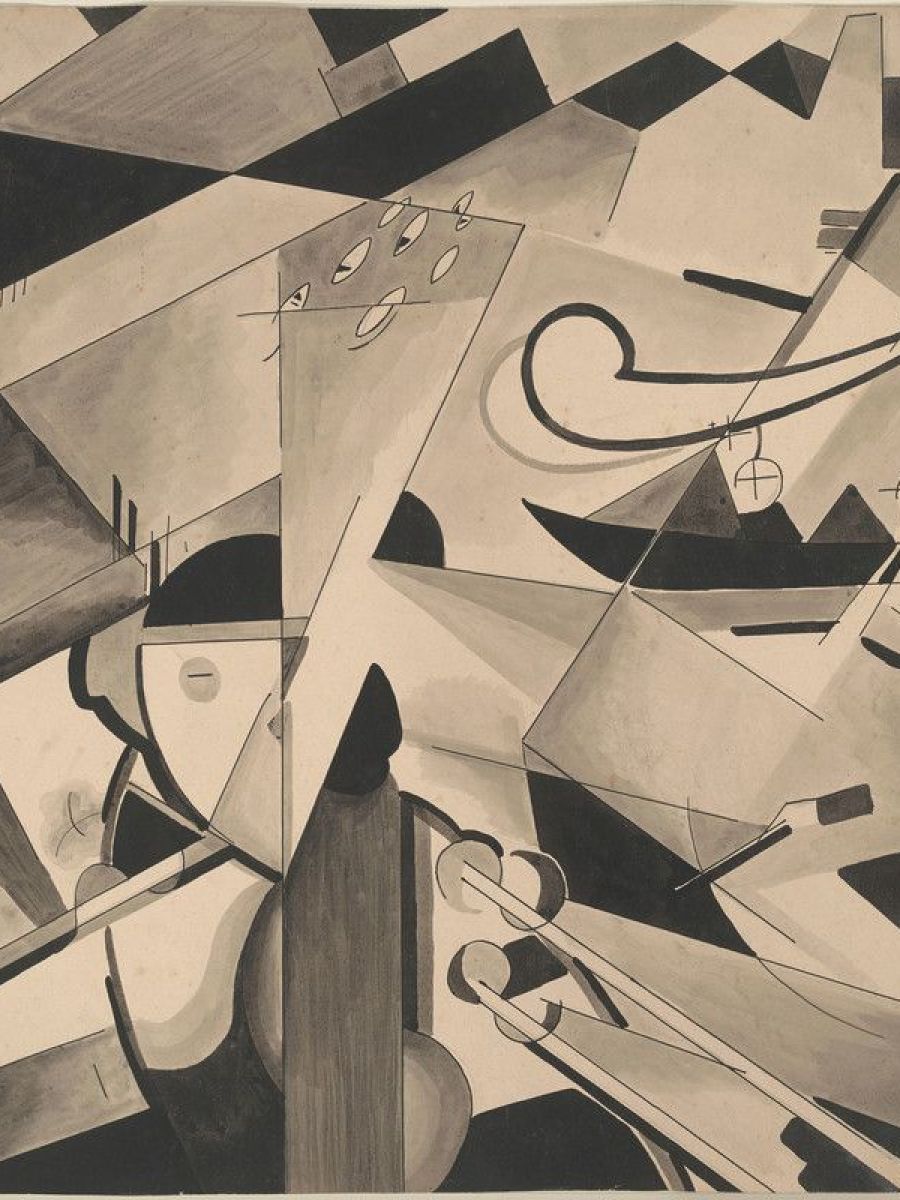
The Oarsmen - Jos Leonard, 1919, KMSKA
Diana
Diana, the Roman goddess of the hunt, is depicted here in a moment of stillness by sculptor Josuë Dupon (1864–1935), just after releasing her arrow. The goddess stands with her feet on the skull of an elk. Her gaze is directed upward, and her outstretched arm still holds the bow in the air—everything contributes to the upward dynamism of this small sculpture. The bow is no longer drawn, but Diana’s eyes follow the arrow—has she hit her target, perhaps a bird? Her athletic body is crafted from precious ivory, combined with bronze (the flowing cloak over her shoulders and the left side of her body) and brass. Diana can be recognized not only by her activity but also by her attributes: the bow, the quiver at her feet, and the small reliefs on each side depicting myths associated with her—the goddess with a stag, after bathing, with a monster, and with a crescent moon. As a moon goddess, Diana originally wore a crescent as a diadem, but this headdress has since disappeared. Dupon is primarily known for his large-scale animal sculptures, such as Vulture Defending Its Prey in the museum garden. Here, however, he demonstrates that he could also bring a female athletic body to life on a small scale, with exquisite refinement.
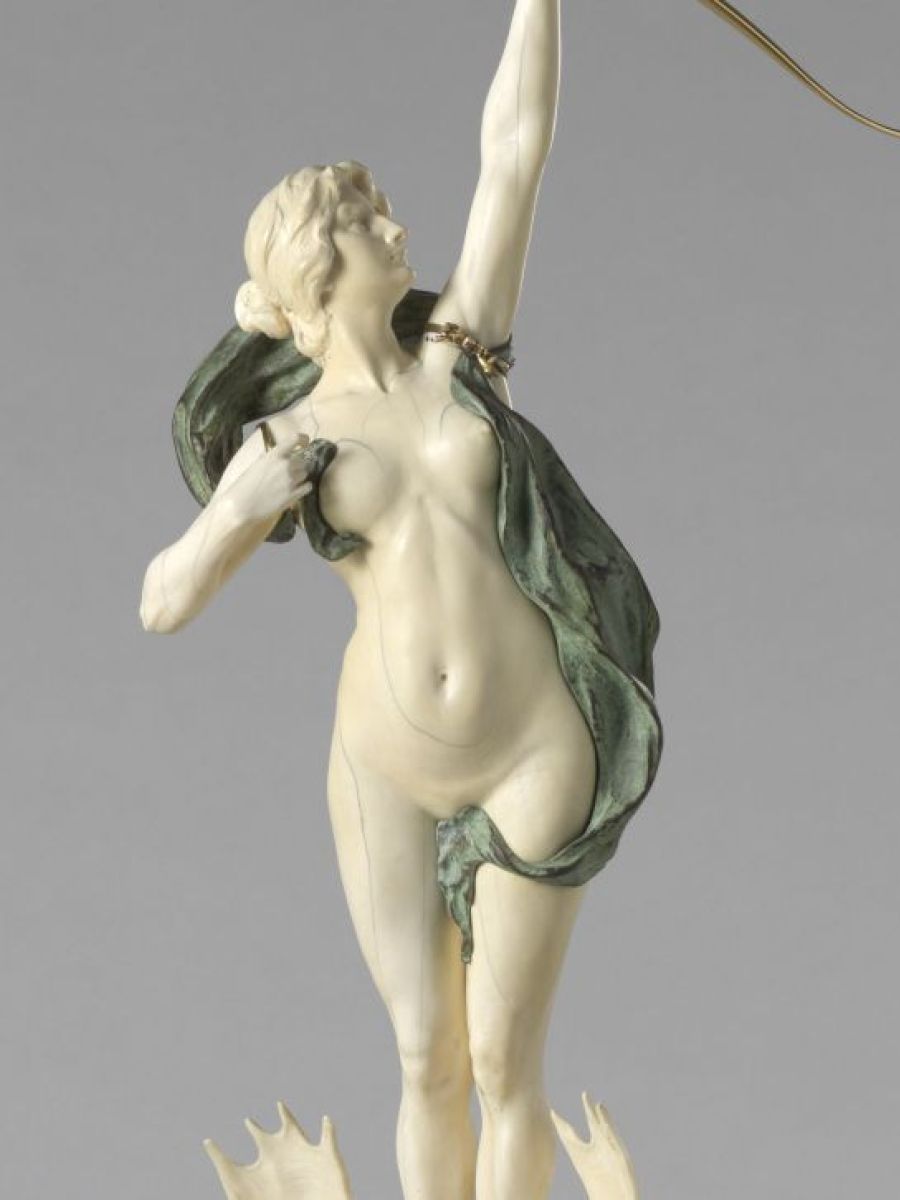
Diana - Josuë Dupon, c. 1896, KMSKA


