Three new insights into the collection

1. The names of these Walloon peasant girls have been rediscovered
Siska Beele: “From 1883 onwards, the Brussels-based Léon Frédéric (1856–1940) spent weeks, sometimes months, in the picturesque village of Nafraiture in the Belgian Ardennes. There he found a variety of models. In 1888, he created the stunning Les Boëchelles—a Walloon dialect word for girls. Two girls are depicted in a shabby peasant interior, sisters, identifiable by their hair color, faces, and clothing. However, the names of the girls remained unknown.”

Élodie Lamotte alone in 1893 - KMSKB

Élodie Lamotte as the younger sister in 1888
“Until now. The French art historian Benjamin Foudral was able to identify them as Élodie and Aline Lamotte from Nafraiture. He based this on Frédéric’s 1893 portrait of Élodie Lamotte from the KMSKB collection. Élodie’s facial features and age in that portrait match those of the younger sister in the 1888 portrait. Born on March 12, 1877, Élodie’s older sister Aline was 11 years old in the double portrait, which also aligns with the painting in our collection. Finally, the background with the wooden paneling and weathered blue wall confirms the identification.”
2. Paul Joostens identified with a female film star
Adriaan Gonnissen: “Asta Nielsen was the Danish star actress of German silent films in the 1910s and 1920s. As the first true film goddess, she set many men aflame. The Antwerp friends Paul Joostens and Paul Van Ostaijen also fell for her charms. At Cinema Zoologie on the former Statieplein or at Cinema Palace on the De Keyserlei, they fully surrendered to the magic of film and the graceful movements of ‘our Asta.’”

Asta Nielsen

Circus, cabaret, or fairground performance - Paul Joostens
“From 1917 onwards, Asta Nielsen appears increasingly in Paul Joostens’s drawings. Sometimes dancing nude—recognizable mainly by her feathered headdress—sometimes in profile amid angular, shifting shapes. Yet there is often something unusual about Asta’s pronounced nose. Joostens did not draw her ‘from life’ but rather created self-portraits, with his own characteristic nose. The artist was so immersed in his idolization of the erotic film diva that he identified himself with her in his artworks.”

Composition with the head of a woman - Paul Joosten

Paul Joostens
3. This kitchen is more like a brothel
Koen Bulckens: “Where earlier generations saw a ‘kitchen’ or an ‘inn’ in this scene by Joachim Beuckelaer, research clearly points to a brothel. This is indicated by the man entering from the back room. Beuckelaer had previously painted a similar composition, now in the Walters Art Museum. That painting leaves no doubt about the use of such a back room: a man with his trousers down stands before a woman lying on a bed.”
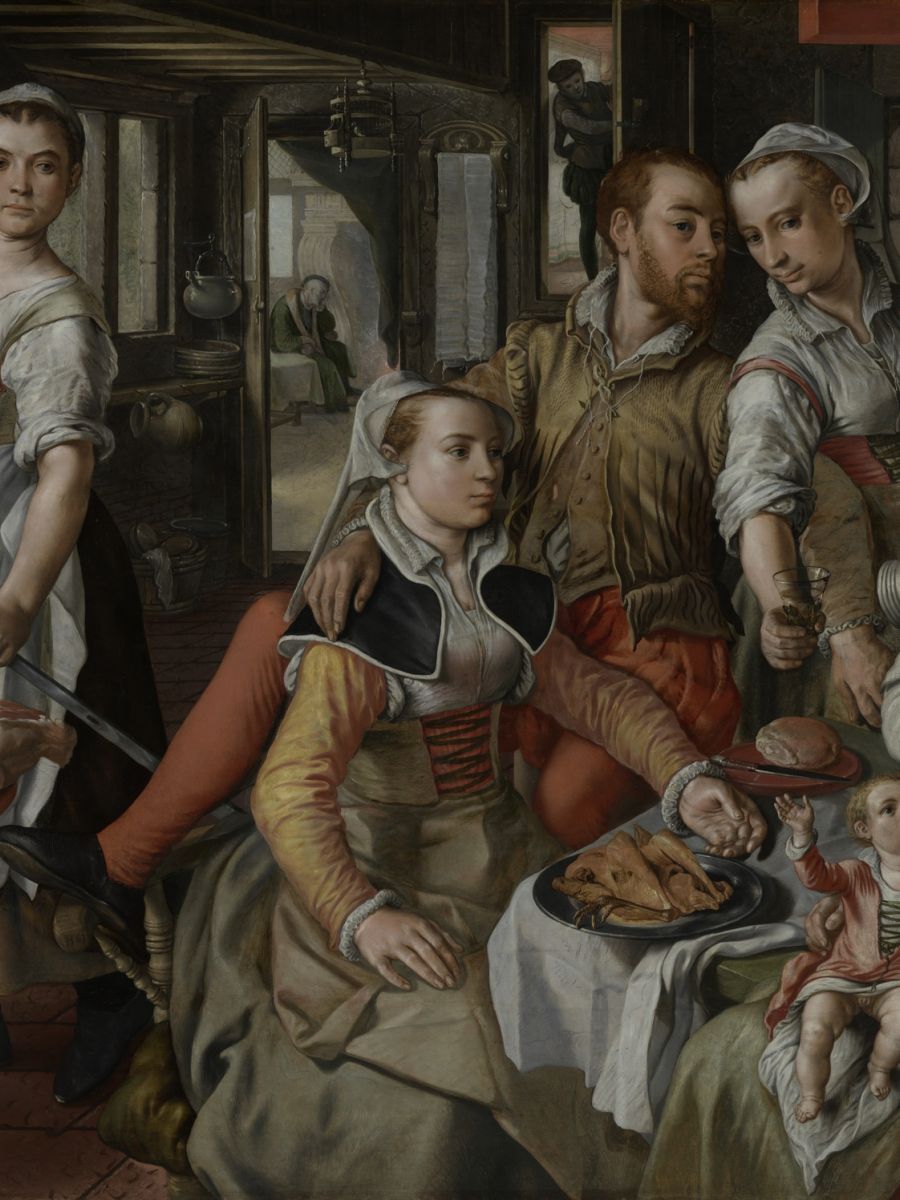
Joachim Beuckelaer’s Allegory of Carelessness from 1563 does not depict a kitchen
“The Antwerp brothel scene contains a cleaned-up version of this motif. Beuckelaer based both versions on brothel scenes by the Monogrammist of Brunswick. The explicit example showed a drinking man next to a woman rising from bed. In the ‘clean’ version at the National Gallery by the same artist, a man and a woman enter the front room fully clothed. The signature indicates that Beuckelaer intended to follow the London version. Infrared imaging shows that he first sketched two figures in the doorway.”

An earlier brothel scene by Joachim Beuckelaer from 1562 (Walters Art Museum collection)

Copy after the Monogrammist of Brunswick from the KMSKB collection

Copy after the Monogrammist of Brunswick from the National Gallery


