On sounds and colors

By Christine Van Mulders
The renowned Goeyvaerts String Trio is one of the Artists in Residence at the KMSKA. The trio performs compositions from the 20th and 21st centuries. What do they stand for, and what does their residency involve? A conversation with Kris Matthynssens, Pieter Stas, and Fedra Coppens.
“We chose the name Goeyvaerts because we have great admiration for the composer Karel Goeyvaerts (1923–1993), who represented many styles in both his playing and his compositions. We also perform almost all music from the periods of Eugène-Auguste Ysaÿe, starting around 1920, as well as works by Anton Webern, Iannis Xenakis, and Arvo Pärt. We do not limit ourselves to specific musical styles, such as New Complexity or twelve-tone technique. Only a few exceptions have led us to slightly older music, such as Arnold Schönberg’s Verklärte Nacht (1899) for string sextet.”
Why a string trio?
“We consider the string trio an interesting and specific genre, one that is actually underestimated, both in terms of performance and repertoire. It is quite rare that we venture into other ensembles. We deliberately chose the string trio and from the beginning did not want to compete with the many well-known string quartets, which freed us from a certain burden. This choice has also strengthened our connection with more contemporary repertoire. The repertoire is relatively manageable. Many composers wrote only one trio, often at a pivotal point in their career, which makes it particularly intriguing. The more experimental nature of these compositions, which inspires us as a trio, also makes them programmatically interesting.”
You also teach. To what extent has your focus on the string trio influenced your music education?
“Unconsciously, in an educational chamber music context, you pay extra attention to the balance of the individual within the ensemble, which is an important aspect in trios. Furthermore, it goes without saying that our profile as a string trio influences the repertoire we present and the design of specific projects.”
“In several projects with the conservatories of Ghent, Antwerp, Brussels, and Amsterdam, students were invited to compose short pieces for trio within a given theme. We became part of their educational experience by immediately interpreting these new scores with our trio. The projects Dots and Pixels, Bach-Cage, and Faustus, connected to the music of Swinnen, Bach, and Schönberg respectively, were extremely enriching. Some participants, such as Frederik Neyrinck, Daan Janssens, and Annelies Van Parys, we now know as successful composers.”
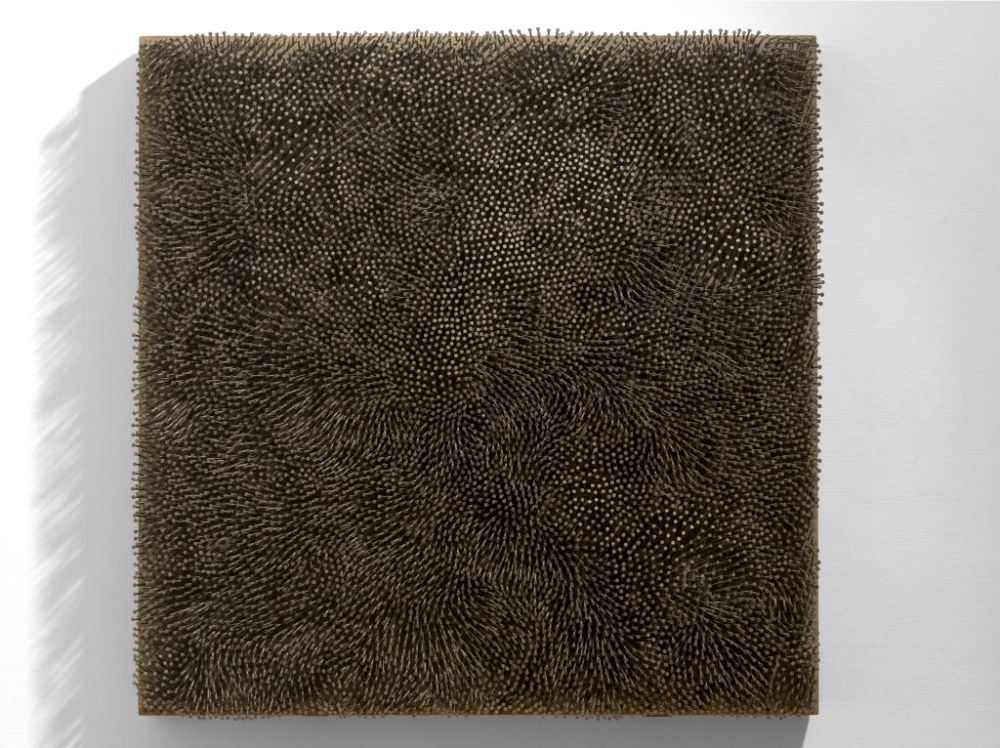
Dark Field - Günther Uecker, 1979, KMSKA
You have built an impressive discography. What is your top three of most important recordings or projects?
“Stabat Mater by Arvo Pärt is certainly at the top. We received the prestigious Edison Prize for it. A great honor, as we are the only chamber music ensemble in Belgium to have received this recognition. It was a remarkable project, with the addition of three singers, the use of Just Intonation, crowdfunding…”
“Beyond that, it is difficult to choose. Anton Webern and Arnold Schoenberg, Sofia Gubaidulina and Giya Kancheli, Nikolai Kondorf, Wolfgang von Schweinitz… Each recording has its own story, specific preparation and focus, a unique overall concept. From our conscious perspective and approach—what do we want to add to the vast musical landscape?—we can say that with each project we achieved something new.”
“The long-term project and intensive collaboration with Charles Wuorinen also belong in our list of top achievements. It began with his appreciation of our interpretation of Schoenberg. He then wanted to write a new composition for the Goeyvaerts String Trio. Ultimately, we found the resources and venue for this extraordinary world premiere: the Guggenheim Museum in New York. A tremendous honor.”
The museum collection offers us an invaluable workspace and performance environment. The concept of timbre takes on an additional dimension here.
What is your main approach when making music?
“We aim to approach and reinterpret a composition each time with fresh eyes, from the context in which we find ourselves at that moment in life. Everything is constantly in motion. No two interpretations are ever the same. Our personalities, ideas, interests, and immediate perceptions are channeled into our interpretations while performing. The advantage of contemporary music is that you are not burdened by precedents, which opens the way to new study and performance methods.”
Finally, you are Artists in Residence. What does that mean for you?
“The essence lies in the connection between sound and image. For us, this story began with our collaboration starting in 1998 with Stef van Bellingen [curator and director of the contemporary art platform WARP in Sint-Niklaas; CVM], as part of a six-part series Sound Colors on art from late Romanticism to the present.”
This article originally appeared in ZAAL Z.


